



Managing a workforce that suddenly went remote is hard enough. Managing it while staying compliant with UAE labour law, WPS, and MOHRE requirements — while your office may be closed, your team scattered across three countries, and your employees asking questions you were not prepared for — is a different challenge entirely.
Remote work during a crisis is not the same as remote work by policy. The legal obligations do not pause because the situation is uncertain. And in the UAE, the gap between what employers assume is acceptable and what the law actually requires is wide enough to create serious exposure.
Here is what you need to get right.
What UAE Labour Law Says About Remote Work in 2026
UAE Federal Decree-Law No. 33 of 2021 formally recognises remote work, hybrid work, and flexible working arrangements as legitimate employment models. This was a significant shift — and it means remote work during a crisis is legally supported, provided it is properly documented.
The key requirement most employers miss: any change to an employee’s working arrangement must be reflected in writing. A verbal agreement between a manager and an employee that “you can work from home for now” is not enforceable and does not protect either party. If an employee is working remotely under a contract that specifies an office location, the change needs to be documented — at minimum through a written addendum or a formal remote work agreement signed by both parties.
What that document must cover:
- The approved remote work location
- The expected working hours and availability requirements
- Who is responsible for equipment and connectivity costs
- How attendance and productivity will be tracked
- The duration of the arrangement and conditions for returning to office
Without this documentation, you have no legal basis to manage performance, enforce working hours, or defend against a dispute if something goes wrong during the remote period.
Does WPS Compliance Change When Employees Work Remotely?
No. WPS obligations remain identical regardless of where your employees are working. Salaries must be paid on time, through the Wage Protection System, in the full contracted amount.
This is the question most UAE HR managers ask first during a disruption — and the answer is unambiguous. The fact that your office is closed, your team is remote, or your operations are reduced does not create a legal basis to delay, defer, or reduce salary payments through WPS. Any of these actions without written employee consent is a MOHRE violation, and the penalties follow the same timeline regardless of the reason:
- Day 10 after the payment deadline — first-level WPS violation recorded
- Day 17 — work permit processing blocked for the entire company
- Sustained non-compliance — trade licence renewal and government contract eligibility affected
If your payroll process requires physical access to an office system or a desktop banking portal to run WPS submissions, that is a critical gap to close right now. Cloud-based payroll platforms allow your finance or HR team to process and submit payroll from any location — which is exactly the capability a crisis exposes as essential.
What Happens If an Employee Works Remotely From Outside the UAE?
This is where the situation becomes significantly more complex, and where most employers make expensive mistakes.
An employee working from outside the UAE while on a UAE employment contract and UAE residence visa is creating a set of overlapping legal issues that do not resolve themselves:
- Visa implications — a UAE residence visa does not authorise the holder to live and work in another country on a UAE employer’s behalf. If the employee is working from their home country, that country’s immigration and employment regulations may apply, depending on the duration and nature of the work
- The six-month rule — an employee who remains outside the UAE for more than six consecutive months risks automatic cancellation of their UAE residence visa. This clock starts from their exit date, not from when you find out about it
- Tax exposure — extended remote work from another country can create tax residency implications for the employee in that country, and in some cases, permanent establishment risk for the employer
- Contract validity — the employee’s UAE contract specifies UAE as the place of employment. Working from another country may not be covered by that contract, creating ambiguity about which law governs the relationship
None of this means you cannot allow employees to work from outside the UAE temporarily. It means you need to make a deliberate decision, document it, set a clear end date, and monitor the six-month visa threshold for every employee who leaves.
Before any employee works remotely from outside the UAE, give them a signed company letter confirming their active employment status. This is useful at border crossings, for banking purposes, and for any administrative processes in the country they are staying in.
How to Track Attendance for a Remote Workforce
UAE labour law requires employers to maintain accurate records of working hours, leave taken, and attendance. The method of tracking does not have to be biometric — but it does have to be verifiable and consistent.
For a remote workforce, your options include:
- Digital check-in systems through your HR platform — employees log in at the start and end of their working day from any device
- Scheduled daily check-ins with line managers — documented in writing
- Project management tools that create a timestamped record of work activity
What you cannot rely on: WhatsApp messages, informal email check-ins, or manager judgment. These create no auditable record and provide no protection in a dispute.
If an employee claims they worked their full contracted hours during a remote period and you have no system to verify or dispute this, you have no grounds for any deduction or disciplinary action — regardless of the actual situation.
Your Remote Work Crisis Checklist
- Issue a written remote work agreement to every employee working from a non-contracted location — even temporarily
- Confirm payroll will run on time and WPS submissions are not dependent on physical office access
- Identify every employee currently outside the UAE and record their exit date — calculate when the six-month visa threshold is reached
- Give any employee working from outside the UAE a signed company letter confirming their active employment status
- Switch to a digital attendance tracking system if you are still relying on physical sign-in
- Review employment contracts for any clauses that specify office location or working jurisdiction — flag any that may need amendment
- Do not agree to salary deferrals, reductions, or unpaid leave without a written mutual agreement signed by both parties
- Ensure your payroll platform is cloud-based and accessible remotely — test this before you need it
Why Remote Work Exposes Manual HR Processes Immediately
A crisis does not create HR problems — it reveals the ones that already existed. Companies that were managing attendance on paper, running payroll through a desktop-only system, storing contracts in a physical filing cabinet, and tracking leave through email are discovering right now that none of those processes survive a sudden move to remote operations.
The companies managing remote workforces cleanly during this period are the ones with cloud-based HR systems where employees can check in, request leave, view payslips, and access their own documents from any device — and where HR can run payroll, monitor WPS compliance, and track visa expiry dates without needing to be in the office.
Over 4,000 UAE companies use Bayzat to manage HR, payroll, attendance, leave, and visa tracking from a single platform that works from anywhere. When the office closes, Bayzat keeps running.

Managing a workforce that suddenly went remote is hard enough. Managing it while staying compliant with UAE labour law, WPS, and MOHRE requirements — while your office may be closed, your team scattered across three countries, and your employees asking questions you were not prepared for — is a different challenge entirely.
Remote work during a crisis is not the same as remote work by policy. The legal obligations do not pause because the situation is uncertain. And in the UAE, the gap between what employers assume is acceptable and what the law actually requires is wide enough to create serious exposure.
Here is what you need to get right.
What UAE Labour Law Says About Remote Work in 2026
UAE Federal Decree-Law No. 33 of 2021 formally recognises remote work, hybrid work, and flexible working arrangements as legitimate employment models. This was a significant shift — and it means remote work during a crisis is legally supported, provided it is properly documented.
The key requirement most employers miss: any change to an employee’s working arrangement must be reflected in writing. A verbal agreement between a manager and an employee that “you can work from home for now” is not enforceable and does not protect either party. If an employee is working remotely under a contract that specifies an office location, the change needs to be documented — at minimum through a written addendum or a formal remote work agreement signed by both parties.
What that document must cover:
- The approved remote work location
- The expected working hours and availability requirements
- Who is responsible for equipment and connectivity costs
- How attendance and productivity will be tracked
- The duration of the arrangement and conditions for returning to office
Without this documentation, you have no legal basis to manage performance, enforce working hours, or defend against a dispute if something goes wrong during the remote period.
Does WPS Compliance Change When Employees Work Remotely?
No. WPS obligations remain identical regardless of where your employees are working. Salaries must be paid on time, through the Wage Protection System, in the full contracted amount.
This is the question most UAE HR managers ask first during a disruption — and the answer is unambiguous. The fact that your office is closed, your team is remote, or your operations are reduced does not create a legal basis to delay, defer, or reduce salary payments through WPS. Any of these actions without written employee consent is a MOHRE violation, and the penalties follow the same timeline regardless of the reason:
- Day 10 after the payment deadline — first-level WPS violation recorded
- Day 17 — work permit processing blocked for the entire company
- Sustained non-compliance — trade licence renewal and government contract eligibility affected
If your payroll process requires physical access to an office system or a desktop banking portal to run WPS submissions, that is a critical gap to close right now. Cloud-based payroll platforms allow your finance or HR team to process and submit payroll from any location — which is exactly the capability a crisis exposes as essential.
What Happens If an Employee Works Remotely From Outside the UAE?
This is where the situation becomes significantly more complex, and where most employers make expensive mistakes.
An employee working from outside the UAE while on a UAE employment contract and UAE residence visa is creating a set of overlapping legal issues that do not resolve themselves:
- Visa implications — a UAE residence visa does not authorise the holder to live and work in another country on a UAE employer’s behalf. If the employee is working from their home country, that country’s immigration and employment regulations may apply, depending on the duration and nature of the work
- The six-month rule — an employee who remains outside the UAE for more than six consecutive months risks automatic cancellation of their UAE residence visa. This clock starts from their exit date, not from when you find out about it
- Tax exposure — extended remote work from another country can create tax residency implications for the employee in that country, and in some cases, permanent establishment risk for the employer
- Contract validity — the employee’s UAE contract specifies UAE as the place of employment. Working from another country may not be covered by that contract, creating ambiguity about which law governs the relationship
None of this means you cannot allow employees to work from outside the UAE temporarily. It means you need to make a deliberate decision, document it, set a clear end date, and monitor the six-month visa threshold for every employee who leaves.
Before any employee works remotely from outside the UAE, give them a signed company letter confirming their active employment status. This is useful at border crossings, for banking purposes, and for any administrative processes in the country they are staying in.
How to Track Attendance for a Remote Workforce
UAE labour law requires employers to maintain accurate records of working hours, leave taken, and attendance. The method of tracking does not have to be biometric — but it does have to be verifiable and consistent.
For a remote workforce, your options include:
- Digital check-in systems through your HR platform — employees log in at the start and end of their working day from any device
- Scheduled daily check-ins with line managers — documented in writing
- Project management tools that create a timestamped record of work activity
What you cannot rely on: WhatsApp messages, informal email check-ins, or manager judgment. These create no auditable record and provide no protection in a dispute.
If an employee claims they worked their full contracted hours during a remote period and you have no system to verify or dispute this, you have no grounds for any deduction or disciplinary action — regardless of the actual situation.
Your Remote Work Crisis Checklist
- Issue a written remote work agreement to every employee working from a non-contracted location — even temporarily
- Confirm payroll will run on time and WPS submissions are not dependent on physical office access
- Identify every employee currently outside the UAE and record their exit date — calculate when the six-month visa threshold is reached
- Give any employee working from outside the UAE a signed company letter confirming their active employment status
- Switch to a digital attendance tracking system if you are still relying on physical sign-in
- Review employment contracts for any clauses that specify office location or working jurisdiction — flag any that may need amendment
- Do not agree to salary deferrals, reductions, or unpaid leave without a written mutual agreement signed by both parties
- Ensure your payroll platform is cloud-based and accessible remotely — test this before you need it
Why Remote Work Exposes Manual HR Processes Immediately
A crisis does not create HR problems — it reveals the ones that already existed. Companies that were managing attendance on paper, running payroll through a desktop-only system, storing contracts in a physical filing cabinet, and tracking leave through email are discovering right now that none of those processes survive a sudden move to remote operations.
The companies managing remote workforces cleanly during this period are the ones with cloud-based HR systems where employees can check in, request leave, view payslips, and access their own documents from any device — and where HR can run payroll, monitor WPS compliance, and track visa expiry dates without needing to be in the office.
Over 4,000 UAE companies use Bayzat to manage HR, payroll, attendance, leave, and visa tracking from a single platform that works from anywhere. When the office closes, Bayzat keeps running.

Noor Gharib
Related Articles
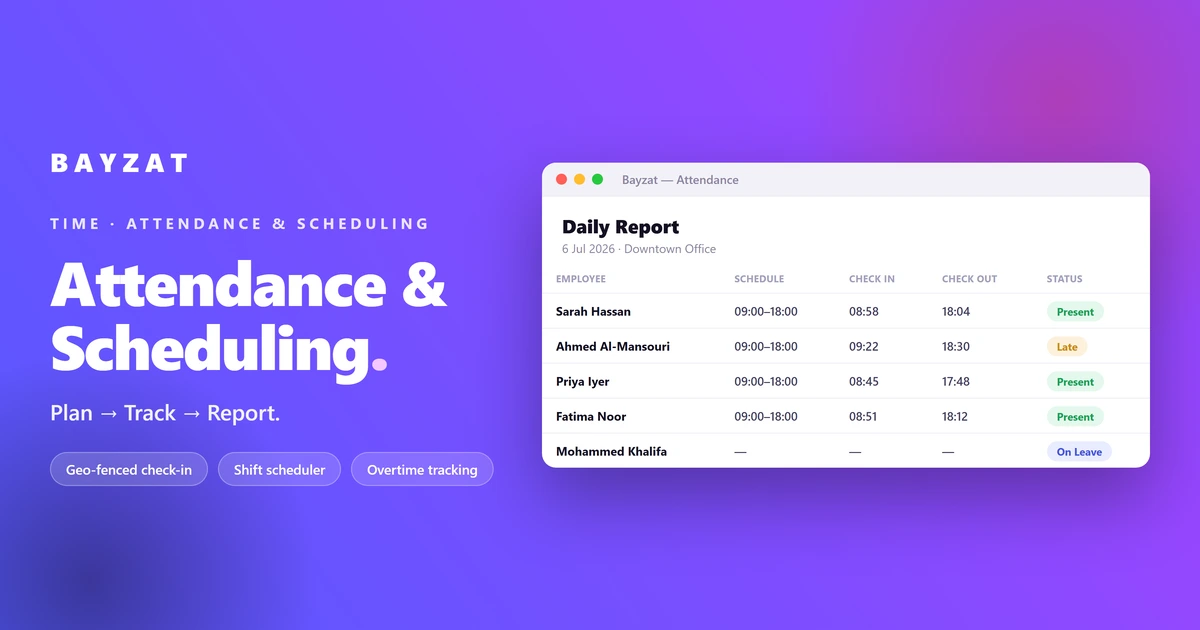
Attendance across the GCC is not just a time-tracking problem. It is a compliance problem — and a connectivity one. Working hours, overtime, rest breaks and leave all have to […]

Payroll in the GCC is not a spreadsheet problem. It is a compliance problem. Between the UAE’s Wage Protection System, KSA’s GOSI contributions, Mudad integration, end-of-service gratuity calculations, and the […]
Employees are asking questions HR teams were not prepared for. Can I work from another country temporarily? What happens to my visa if I leave? Will the company still pay […]





Get Social