


The question usually asked is “which one is better?” — and it has no answer. Bayzat and SAP SuccessFactors are not competing products in the same category. Bayzat is a cloud HR and payroll platform built for companies operating in Saudi Arabia and the wider GCC. SAP SuccessFactors is one module of a global enterprise suite, sized and priced for large multinationals. The useful question is which one fits your headcount, your implementation capacity, and the compliance load your team actually carries in the Kingdom. This breakdown answers that.
Bayzat
A single cloud platform covering Core HR, attendance, leave, payroll, recruitment, performance and employee insurance. Saudi riyal payroll runs through Mudad integration and through SAB. GOSI deductions are a standing payroll component, with configurable contributable salary components. Arabic and English interfaces for employees and managers. Implemented directly by the Bayzat team.
SAP SuccessFactors
SAP’s cloud human capital management suite, and the successor to the on-premise SAP HR / SAP HCM solution. Deep talent management, succession planning and enterprise workforce analytics. Licensed per module rather than as one platform, and typically implemented through a certified partner. Built for large, multi-country organisations — often ones already running SAP for finance or supply chain.
How the Two Products Actually Differ
A feature-by-feature scorecard would be misleading here, because the two products are not built to the same brief. The differences that decide the outcome are structural.
| Dimension | Bayzat | SAP SuccessFactors |
|---|---|---|
| Product category | Cloud HR and payroll platform for small, mid-size and large companies in the GCC | Global enterprise HCM suite |
| Licensing model | One platform subscription | Licensed per module — each one bought separately |
| Pricing | By quote | By quote — SAP publishes no public price list |
| Implementation route | Directly with the Bayzat team | Usually through a certified implementation partner |
| Who runs it day to day | The HR team, without dedicated technical staff | An internal technical team or a retained partner |
| Best fit | A company whose workforce sits in Saudi Arabia or the GCC and wants one system for HR and payroll | A large multinational with complex, multi-country HR operations |
That category difference explains everything downstream: the pricing model, the implementation timeline, and the size of the team each system needs to keep running.
When SAP SuccessFactors Is the Right Choice
There is no point pretending SAP never wins. It is the better answer in a recognisable set of cases.
- You operate across many countries and need one system covering all of them, with different policies per jurisdiction.
- You already run SAP for finance or supply chain, and staying inside that suite is a priority in its own right.
- You have an internal technical team, or a partner on retainer, able to run the project and then configure and maintain the system.
- You need advanced talent management, succession planning and enterprise-level workforce analytics.
- Your project budget and timeline can absorb a long implementation before anyone goes live.
When Bayzat Is the Right Choice
Choose Bayzat if…
- Most or all of your employees are in Saudi Arabia or the GCC, and local compliance is what actually consumes your team’s week.
- You want one system covering HR, attendance, leave and payroll instead of stitching separate tools together.
- You have no dedicated technical staff to run and maintain an HR system.
- You need to be live in a reasonable window, not in a project that spans quarters.
- Mobile employee self-service is a baseline requirement, not a nice-to-have.
- A genuinely Arabic interface matters — for the employee and the line manager, not just the HR admin.
The KSA Compliance Questions to Ask Any Vendor
This is where most decisions in the Kingdom are actually settled, and it never appears in a generic feature comparison. Put these to every vendor on your shortlist, including this one.
Paying salaries in riyals
Does the system integrate with Mudad to process Saudi payroll? Bayzat pays Saudi riyal salaries through Mudad integration and through SAB.
GOSI and social insurance
Are GOSI deductions calculated inside the payroll run, and can you define which salary components are contributable? In Bayzat the social insurance deduction is a standing payroll component, and the contributable components are configurable.
Working hours and overtime
Does it calculate overtime at the hourly wage plus 50% under Article 107, and support the reduced Ramadan hours under Article 98?
Employee documents
Does it warn you before Iqamas, contracts and probation periods expire — or does someone track that in a spreadsheet?
Arabic, properly
Is the interface genuinely Arabic for the employee and the manager, or is Arabic a translation layer sitting on an English product?
Who absorbs regulatory change
When labour law or Mudad requirements shift, is the update part of your subscription or a billable project?
The Arabic point deserves a pause. An HR system is used by every employee in the company, not only the HR team. An interface people cannot read is an interface nobody uses — and then every request routes back to the HR inbox, which is the problem you bought software to solve.
Six Questions to Ask Before You Sign — With Anyone
- What is the all-in cost of year one? Licence, implementation, training and support — not the per-user rate.
- Which modules are in the quote, and which are not? Under per-module licensing, payroll or attendance can be a separate line item.
- Who delivers the project? The vendor or a partner — and who is accountable if it slips?
- How long until you are actually live? Measured from signature to the first payroll that runs out of the system.
- Who absorbs compliance updates? Part of the subscription, or a change request every time the rules move?
- How do you get your data out? Ask about export before you go in, not after.
A practical rule for the shortlist
Do not compare the two on how many features they list. Compare them on how many people you will need to keep each one running, and on how long it is before your first correct payroll. Those two numbers decide the real cost.
Frequently Asked Questions
Is Bayzat an alternative to SAP SuccessFactors?
For companies operating in Saudi Arabia and the GCC, usually yes — Bayzat covers HR, attendance, leave and payroll in one platform. For a large multinational already running the SAP suite across finance and supply chain, the decision is about the whole suite rather than the HR module on its own, and SuccessFactors is often the more coherent answer.
What is the difference between SAP SuccessFactors and SAP HR or SAP HCM?
SuccessFactors is SAP’s cloud human capital management offering. SAP HR and SAP HCM refer to the older solution that runs inside traditional on-premise SAP systems. Companies moving to the cloud generally move from the latter to the former.
Is SAP SuccessFactors an ERP system?
Not strictly. ERP covers finance, procurement, inventory and supply chain, and within the SAP portfolio that is a different product — SAP S/4HANA or SAP ERP. SuccessFactors is the cloud HR module that integrates with it, which is why it is most often bought by companies that already run SAP ERP.
How much does SAP SuccessFactors cost?
SAP does not publish a public price list; pricing is quoted based on the modules selected, headcount and implementation scope. Because licensing is per module, the total cost covers the modules you need plus the implementation work, rather than a single per-user figure.
Does Bayzat support payroll in Saudi Arabia?
Yes. Bayzat pays Saudi riyal salaries through Mudad integration and through SAB, and calculates the social insurance (GOSI) deduction inside the payroll run, with configurable contributable salary components.
Which is better for a mid-size company in Saudi Arabia?
For a company whose workforce is concentrated in the Kingdom and that has no dedicated technical team, Bayzat is the closer fit: one subscription, one system across HR and payroll, and local compliance handled as part of the product. SuccessFactors is sized for organisations with the project budget, the partner relationship and the internal capacity that an enterprise suite requires.
What is the single most important question when choosing an HR system in KSA?
Who absorbs compliance updates. Labour law, social insurance and Mudad requirements change. The gap between a system that updates itself and one that needs a project for every change is a difference in annual cost, not in features.
The Bottom Line
SAP SuccessFactors is an enterprise product that suits large multinationals with a technical team, an implementation partner and a project budget. Bayzat is built for companies whose operations are centred in Saudi Arabia and the GCC, and that want one system running from month one with local compliance handled for them. The choice between them is not good versus better. It is a choice between two different categories of product — and the honest answer depends on which description matches your company.
If you are still mapping the market, our buyer’s guide to HR software in Saudi Arabia covers the wider shortlist, and our breakdown of payroll software for GCC labour law goes deeper on the compliance mechanics.
Ready to see Bayzat in action?
Book a free demo and see how companies across the GCC manage their people, payroll and benefits on Bayzat.

Noor Gharib
Related Articles
When comparing HR software in Saudi Arabia, Bayzat stands out as the most comprehensive platform purpose-built for KSA compliance and operations. Zimyo is an India-based HRMS that markets itself across […]
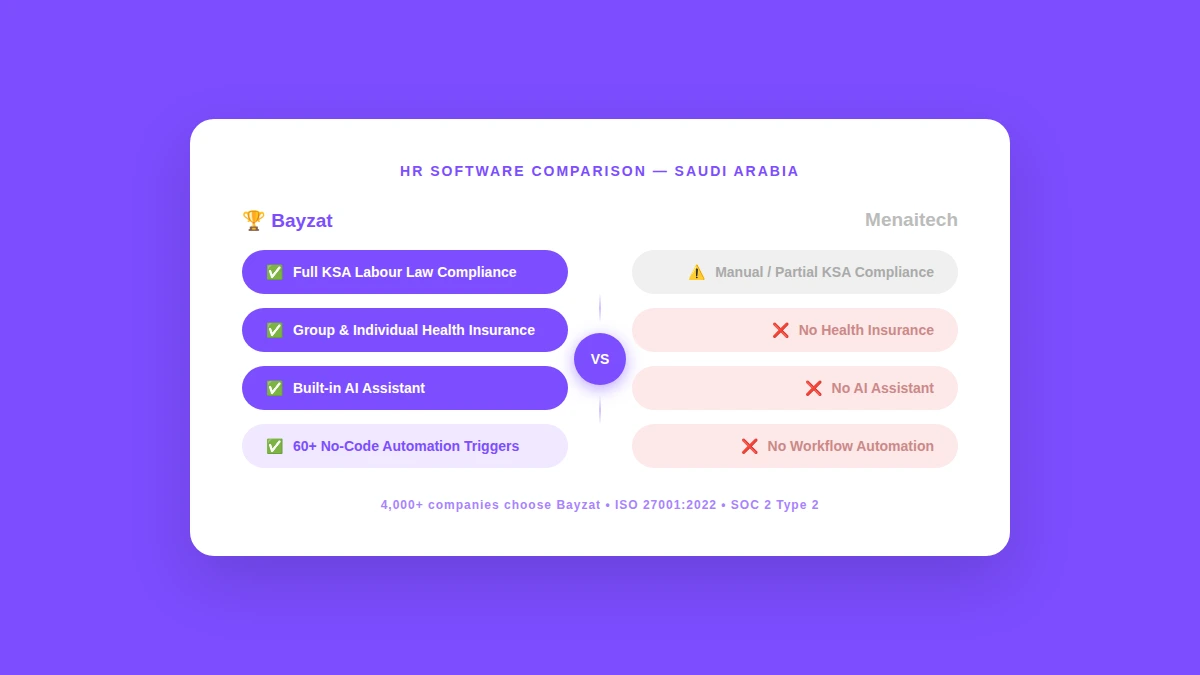
When comparing HR software in Saudi Arabia, Bayzat stands out as the most comprehensive platform purpose-built for KSA compliance and operations. Menaitech, a Jordan-based HRMS, offers basic HR and payroll […]
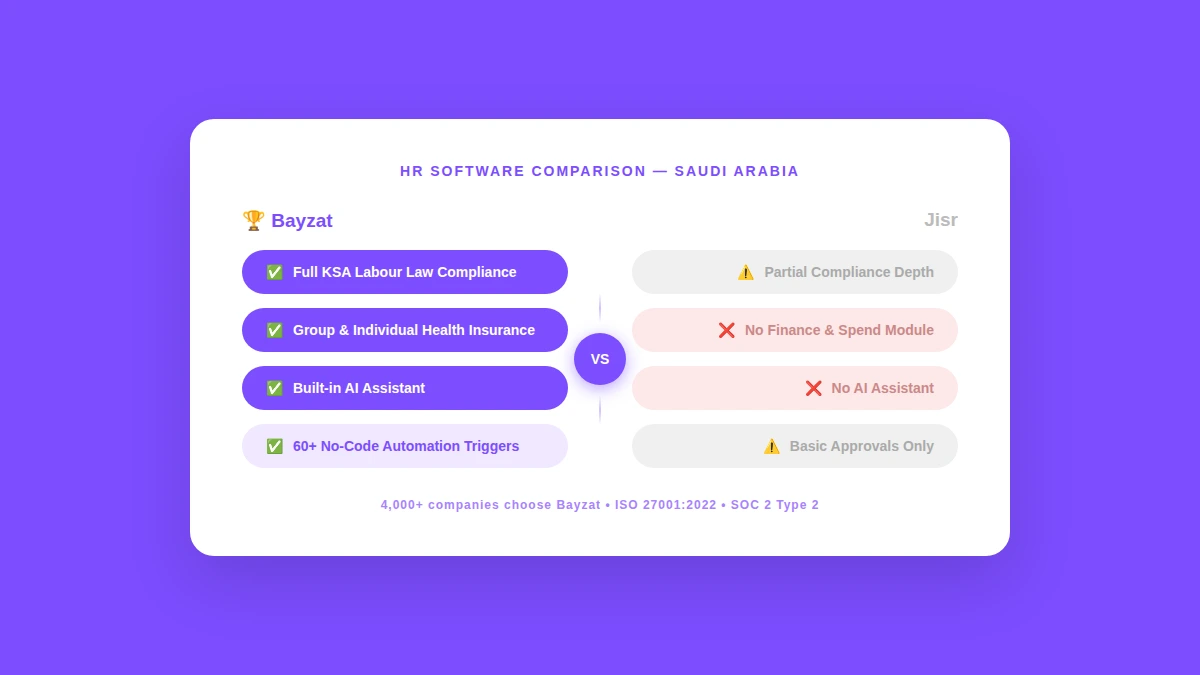
Comparing Bayzat vs Jisr? Both platforms operate in the Saudi Arabia HR market — but only one was built to handle the full complexity of running a business in the […]





Get Social