



Hiring the right person has never been more competitive — or more costly. According to SHRM, the average cost per hire exceeds $4,700, and the average time to fill a role stretches beyond 44 days. For HR teams juggling multiple open positions, the pressure to move fast without sacrificing quality is immense.
That’s where an Applicant Tracking System (ATS) comes in. But beyond the buzzword, how does an ATS actually improve your hiring process? Here’s a clear, practical breakdown.
What Is an Applicant Tracking System (ATS)?
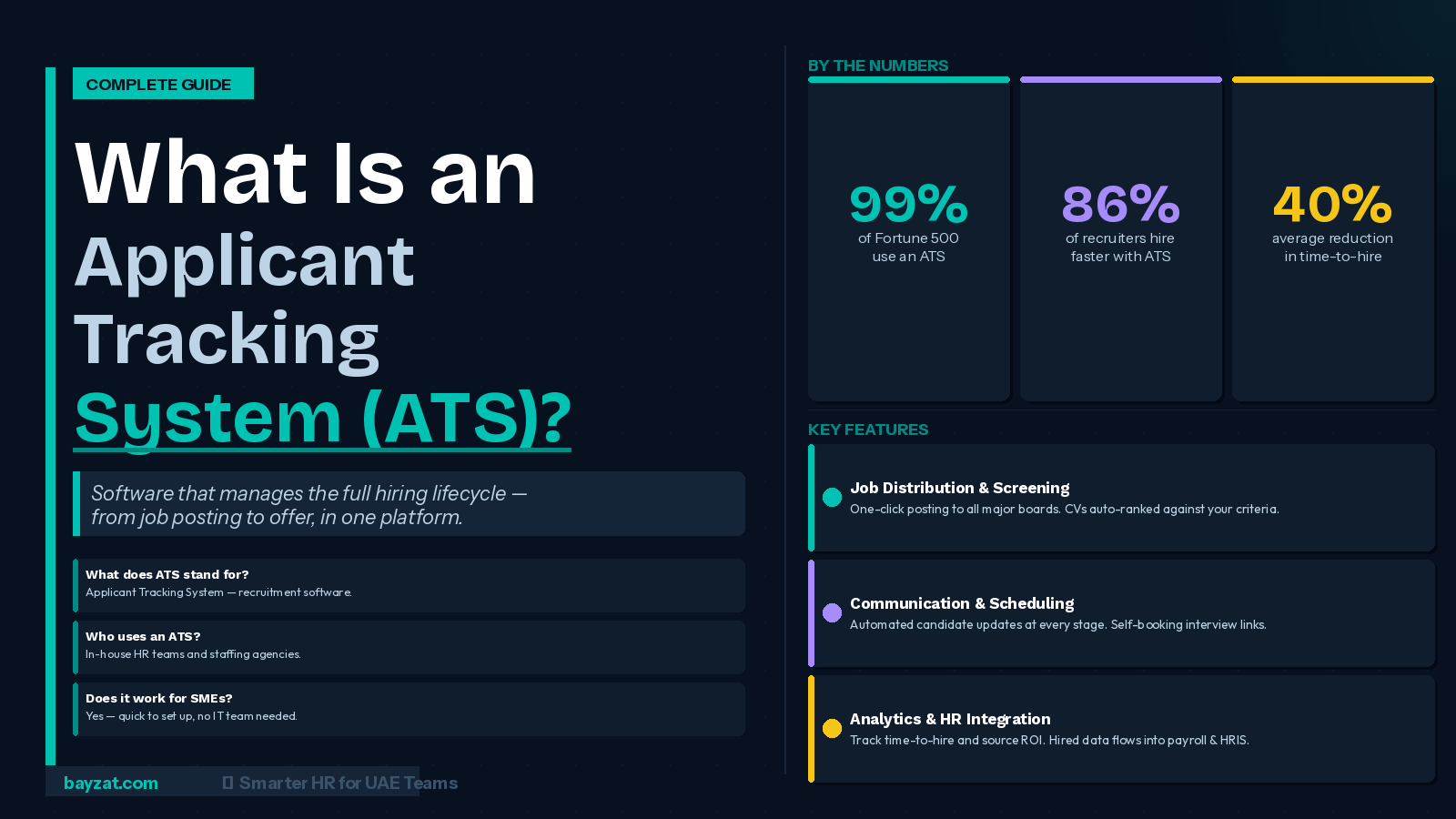
An ATS is recruitment software that manages the full hiring lifecycle — from job posting to offer acceptance — in a single centralized platform. It collects applications from multiple sources, screens and ranks candidates automatically, routes them through your custom hiring stages, and keeps every stakeholder aligned along the way.
When integrated into a broader HR platform like Bayzat, the benefits extend even further: a hired candidate’s data flows directly into payroll, onboarding, and employee records without any manual re-entry.
5 Ways an ATS Improves Your Hiring Process
1. Faster, Wider Job Distribution
Without an ATS, posting a role means logging into each job board separately, reformatting the description, and manually tracking where applicants come from. An ATS eliminates this entirely — one job post pushes to multiple boards simultaneously, including LinkedIn, Indeed, and Naukrigulf, with a single click.
Beyond saving time, the system tracks which channels produce the most qualified applicants, so your team can invest your sourcing budget where it actually works.
2. Automated Screening That Surfaces the Right Candidates
The average corporate job posting receives over 250 applications. Manually reviewing every CV is not just slow — it’s where great candidates get missed and unconscious bias creeps in.
An ATS automates the initial screening layer by scanning resumes against the criteria you define: required qualifications, years of experience, skills, and more. Candidates are automatically ranked so your team focuses its energy on the top-fit applicants from the start.
This is especially critical when hiring at volume — whether you’re scaling rapidly, filling seasonal roles, or managing multiple openings across departments at the same time.
3. Reduced Time-to-Hire Through Process Automation
Time-to-hire is one of the most telling recruitment metrics — and one of the most directly impacted by ATS adoption. Organizations using an ATS typically reduce their average time-to-hire by 20–40%. Here’s where those gains come from:
| Manual Process | With ATS |
| Posting jobs one board at a time | One-click multi-board distribution |
| Emailing candidates individually | Automated, stage-based communication |
| Scheduling interviews by email | Self-scheduling links sent to candidates |
| Tracking applicants in spreadsheets | Live pipeline view with stage tracking |
| Chasing hiring manager feedback | Structured in-system scorecards |
Each of these automations removes hours from every hire — and the savings compound across every open role you manage throughout the year.
4. A Candidate Experience That Protects Your Employer Brand
Every applicant who doesn’t get the job still walks away with an impression of your company — and they talk. Research shows that candidates who have a positive hiring experience are significantly more likely to accept an offer, reapply in the future, and recommend your company to others.
An ATS improves the candidate experience through:
- Mobile-friendly applications candidates can complete in minutes on any device
- Automated status updates so no one is left wondering where they stand
- Self-scheduling for interviews that puts control in the candidate’s hands
- Timely rejection messages that preserve goodwill with everyone who applied
In the GCC, where top talent is actively courted by multiple employers simultaneously, a slow or disorganized hiring process doesn’t just delay a hire — it loses it.
5. Data and Analytics That Turn Recruiting Into a Strategic Function
Without an ATS, most organizations have little visibility into where candidates drop off, which sources actually produce good hires, or how long each stage of hiring takes. Decisions get made on instinct rather than evidence.
With an ATS, HR teams gain access to a live recruitment dashboard tracking:
- Time-to-fill by role and department
- Candidate source quality and ROI
- Pipeline conversion rates at each stage
- Offer acceptance rates and decline reasons
- Cost per hire across sourcing channels
For HR managers reporting to leadership, this kind of data changes the conversation entirely — transforming recruiting from an operational function into a strategic one with measurable business impact.
ATS Benefits at a Glance
|
Challenge |
Without ATS | With ATS |
| Job posting reach | Manual, platform by platform |
Multi-board in one click |
|
Resume screening |
Every CV reviewed manually | Automated ranking against criteria |
| Candidate communication |
Ad hoc, inconsistent |
Automated, personalized at scale |
| Hiring manager collaboration | Email chains and delays |
Structured in-system scorecards |
|
Time-to-hire |
44+ days average |
Reduced by 20–40% |
|
Recruitment analytics |
Spreadsheets or none |
Live dashboards and reports |
How Bayzat’s ATS Works End-to-End
Bayzat’s recruitment module is built as part of a fully integrated HR platform — meaning the ATS doesn’t operate in isolation. When a candidate is hired, their data flows automatically into employee records, payroll, and benefits without any manual handover.
Bayzat offers:
- A branded careers portal to attract candidates professionally
- Customizable hiring stages tailored to your process
- Automated interview scheduling with candidate self-selection
- Offer letter generation with e-signature support
- Reporting dashboards to track and improve hiring performance over time
This integration between recruiting and the rest of your HR stack is what separates a true HR platform from a standalone ATS — and where Bayzat delivers its clearest advantage for growing companies across the UAE, KSA and GCC.
Frequently Asked Questions
What does ATS stand for?
ATS stands for Applicant Tracking System — software that manages the end-to-end recruitment process from job posting to offer acceptance in one centralized platform.
Is an ATS suitable for small businesses?
Yes. Modern ATS platforms like Bayzat are designed for SMEs, quick to set up, and don’t require a dedicated IT team. Even companies hiring 10–20 people per year benefit from the structure and speed an ATS provides.
Can Bayzat ATS integrate with payroll and HR systems?
The best ATS platforms integrate directly with payroll, onboarding, and HRIS tools. Bayzat’s ATS is built into a unified HR platform, so hired candidate data flows automatically across all modules — no re-entry required.
An ATS is not just a recruitment tool — it’s a strategic investment in hiring quality, team efficiency, and employer brand. For HR teams looking to hire faster and smarter, Bayzat’s ATS brings recruiting and HR together in one place.
Ready to see how it works? Book a free demo with Bayzat and discover how leading companies are cutting time-to-hire while improving the candidate experience.

Hiring the right person has never been more competitive — or more costly. According to SHRM, the average cost per hire exceeds $4,700, and the average time to fill a role stretches beyond 44 days. For HR teams juggling multiple open positions, the pressure to move fast without sacrificing quality is immense.
That’s where an Applicant Tracking System (ATS) comes in. But beyond the buzzword, how does an ATS actually improve your hiring process? Here’s a clear, practical breakdown.
What Is an Applicant Tracking System (ATS)?
An ATS is recruitment software that manages the full hiring lifecycle — from job posting to offer acceptance — in a single centralized platform. It collects applications from multiple sources, screens and ranks candidates automatically, routes them through your custom hiring stages, and keeps every stakeholder aligned along the way.
When integrated into a broader HR platform like Bayzat, the benefits extend even further: a hired candidate’s data flows directly into payroll, onboarding, and employee records without any manual re-entry.
5 Ways an ATS Improves Your Hiring Process
1. Faster, Wider Job Distribution
Without an ATS, posting a role means logging into each job board separately, reformatting the description, and manually tracking where applicants come from. An ATS eliminates this entirely — one job post pushes to multiple boards simultaneously, including LinkedIn, Indeed, and Naukrigulf, with a single click.
Beyond saving time, the system tracks which channels produce the most qualified applicants, so your team can invest your sourcing budget where it actually works.
2. Automated Screening That Surfaces the Right Candidates
The average corporate job posting receives over 250 applications. Manually reviewing every CV is not just slow — it’s where great candidates get missed and unconscious bias creeps in.
An ATS automates the initial screening layer by scanning resumes against the criteria you define: required qualifications, years of experience, skills, and more. Candidates are automatically ranked so your team focuses its energy on the top-fit applicants from the start.
This is especially critical when hiring at volume — whether you’re scaling rapidly, filling seasonal roles, or managing multiple openings across departments at the same time.
3. Reduced Time-to-Hire Through Process Automation
Time-to-hire is one of the most telling recruitment metrics — and one of the most directly impacted by ATS adoption. Organizations using an ATS typically reduce their average time-to-hire by 20–40%. Here’s where those gains come from:
| Manual Process | With ATS |
| Posting jobs one board at a time | One-click multi-board distribution |
| Emailing candidates individually | Automated, stage-based communication |
| Scheduling interviews by email | Self-scheduling links sent to candidates |
| Tracking applicants in spreadsheets | Live pipeline view with stage tracking |
| Chasing hiring manager feedback | Structured in-system scorecards |
Each of these automations removes hours from every hire — and the savings compound across every open role you manage throughout the year.
4. A Candidate Experience That Protects Your Employer Brand
Every applicant who doesn’t get the job still walks away with an impression of your company — and they talk. Research shows that candidates who have a positive hiring experience are significantly more likely to accept an offer, reapply in the future, and recommend your company to others.
An ATS improves the candidate experience through:
- Mobile-friendly applications candidates can complete in minutes on any device
- Automated status updates so no one is left wondering where they stand
- Self-scheduling for interviews that puts control in the candidate’s hands
- Timely rejection messages that preserve goodwill with everyone who applied
In the GCC, where top talent is actively courted by multiple employers simultaneously, a slow or disorganized hiring process doesn’t just delay a hire — it loses it.
5. Data and Analytics That Turn Recruiting Into a Strategic Function
Without an ATS, most organizations have little visibility into where candidates drop off, which sources actually produce good hires, or how long each stage of hiring takes. Decisions get made on instinct rather than evidence.
With an ATS, HR teams gain access to a live recruitment dashboard tracking:
- Time-to-fill by role and department
- Candidate source quality and ROI
- Pipeline conversion rates at each stage
- Offer acceptance rates and decline reasons
- Cost per hire across sourcing channels
For HR managers reporting to leadership, this kind of data changes the conversation entirely — transforming recruiting from an operational function into a strategic one with measurable business impact.
ATS Benefits at a Glance
|
Challenge |
Without ATS | With ATS |
| Job posting reach | Manual, platform by platform |
Multi-board in one click |
|
Resume screening |
Every CV reviewed manually | Automated ranking against criteria |
| Candidate communication |
Ad hoc, inconsistent |
Automated, personalized at scale |
| Hiring manager collaboration | Email chains and delays |
Structured in-system scorecards |
|
Time-to-hire |
44+ days average |
Reduced by 20–40% |
|
Recruitment analytics |
Spreadsheets or none |
Live dashboards and reports |
How Bayzat’s ATS Works End-to-End
Bayzat’s recruitment module is built as part of a fully integrated HR platform — meaning the ATS doesn’t operate in isolation. When a candidate is hired, their data flows automatically into employee records, payroll, and benefits without any manual handover.
Bayzat offers:
- A branded careers portal to attract candidates professionally
- Customizable hiring stages tailored to your process
- Automated interview scheduling with candidate self-selection
- Offer letter generation with e-signature support
- Reporting dashboards to track and improve hiring performance over time
This integration between recruiting and the rest of your HR stack is what separates a true HR platform from a standalone ATS — and where Bayzat delivers its clearest advantage for growing companies across the UAE, KSA and GCC.
Frequently Asked Questions
What does ATS stand for?
ATS stands for Applicant Tracking System — software that manages the end-to-end recruitment process from job posting to offer acceptance in one centralized platform.
Is an ATS suitable for small businesses?
Yes. Modern ATS platforms like Bayzat are designed for SMEs, quick to set up, and don’t require a dedicated IT team. Even companies hiring 10–20 people per year benefit from the structure and speed an ATS provides.
Can Bayzat ATS integrate with payroll and HR systems?
The best ATS platforms integrate directly with payroll, onboarding, and HRIS tools. Bayzat’s ATS is built into a unified HR platform, so hired candidate data flows automatically across all modules — no re-entry required.
An ATS is not just a recruitment tool — it’s a strategic investment in hiring quality, team efficiency, and employer brand. For HR teams looking to hire faster and smarter, Bayzat’s ATS brings recruiting and HR together in one place.
Ready to see how it works? Book a free demo with Bayzat and discover how leading companies are cutting time-to-hire while improving the candidate experience.

Noor Gharib
Related Articles
If you’ve spent any time in HR or recruiting, you’ve heard the term ATS. But what exactly is it, what does it do, and why does it matter؟ This guide […]

“The recruitment process in the UAE is so slow. It’s just very slow, unfortunately. It’s indecision in the process of hiring. It’s a cultural thing. No one wants to decide […]

Attracting the best talents in the UAE has become a rat race as many companies’ HR seek to outsmart each other. Every firm is constantly strategising to attract the most […]





Get Social