



By now, ChatGPT has become a household name in the fields of Artificial Intelligence (AI), Natural Language Processing (NLP), and Large Language Models (LLMs). At the forefront of this revolution, OpenAI’s GPT-3 and its latest version ChatGPT-4 have captured the imagination of millions owing to their increased speed and real-time reasoning across human-like text, audio, and video.
ChatGPT is busy creating newsletters, job postings, emails, resumes, and reports, to name a few. The potential use cases for HR professionals are endless, and with the right prompts, ChatGPT can assist in enhancing efficiency, saving time, and cutting costs.
In this guide, we will explore the fundamentals of prompt engineering and share some practical ChatGPT prompts that HR professionals, particularly UAE-based can utilize across a variety of HR tasks.
What Is ChatGPT Prompts?
Simply put, a prompt is a text that provides direction or context for the AI model to generate output. It acts as an initial input that guides the model on the type of response that is expected. Prompt engineering involves crafting these prompts in a way that elicits the desired outcome from the model.
In other words, the quality and clarity of your prompt directly affect the output’s quality. Just like a good question leads to a good answer, well-crafted prompts are important to unlocking ChatGPT’s potential in HR.
That is, ChatGPT prompts can be tailored specifically for HR tasks and can range from simple command prompts to more complex conversational scripts. They can include codes, keywords, phrases, questions, or even full sentences depending on the task at hand.
Why are Right Prompts So Important?
As we’ve mentioned, prompts are crucial in eliciting the desired output from ChatGPT. Hence, there are several reasons why coming up with the right prompts is essential:
- Custom outputs: Specific prompts allow customized responses. For example, a prompt for candidate screening can be different than a prompt for generating job descriptions.
- Improved accuracy: Well-crafted prompts provide context to the model, leading to more accurate and relevant outputs. They minimize the risk of generating irrelevant or misleading information.
- Focused responses: By providing a clear direction, prompts help ChatGPT stay on topic and generate focused content.
- Human-like interaction: With carefully designed prompts, ChatGPT can produce human-like interactions making it easier for HR professionals to communicate with job seekers or colleagues.
Elements for Effective ChatGPT Prompts
Before you start with the ChatGPT for HR, it’s important to take a step back and understand what makes an effective prompt. ChatGPT requires three key input elements to produce high-quality outputs:
- Objective: The intention or purpose of the response. Is it for candidate screening, job descriptions, or performance reviews?
- Context: The background information or specific details related to the task.
- Format: The structure or style of the output. Will it be in bullet points, a paragraph, or a conversational script?
Let’s illustrate this with a simple example to understand these elements better.
Suppose you want ChatGPT to create a budget report for end-of-year bonuses. Your prompt could look like this:
1. Objective: Generate an end-of-year bonus budget report for the [company name] HR department.
2. Context: The company has 50 employees, and each employee is eligible for a bonus based on their salary and performance.
3. Format: Bullet points with the currency in AED
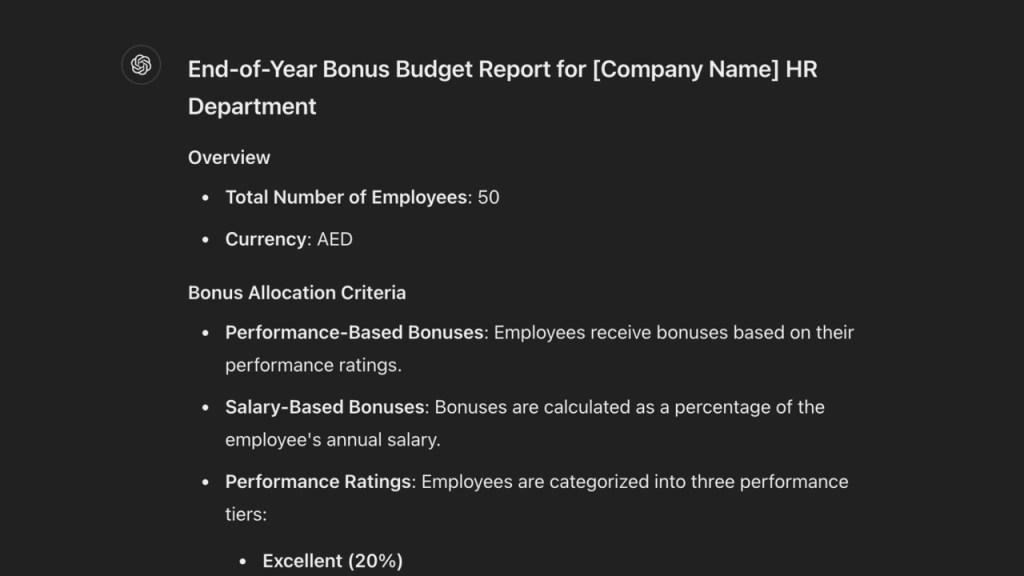
Using these elements, ChatGPT can produce a detailed budget report accurately and efficiently. At the same time, even though the chatbot has access to a massive amount of data, the information generated won’t be accurate and relevant without context.
Tips and Tricks for Crafting Effective ChatGPT Prompts
Apart from the three key elements, there are some tips to keep in mind while creating prompts for ChatGPT:
- Use the latest, paid version of ChatGPT ( currently GPT-4). There are significant improvements in each version, and the latest one can provide better results.
- Be specific and provide as much information as possible to customize the response to your needs. The more precise your prompt is, the better output you’ll receive.
- Avoid using ChatGPT as Google Search. Instead, provide the model with a clear task to complete.
- Sometimes, using multiple prompts in a sequence can yield better results as they build on each other. This is called prompt chaining.
- Experiment with different prompts to see which ones work best for your specific tasks.
26 Practical Applications of ChatGPT Prompts In HR
Research shows that using effective ChatGPT prompts enables HR professionals to save up to 37% of their time spent on various tasks across the different stages of the employee life cycle:
- Recruitment
- Onboarding
- Employee Retention and engagement
- Performance management
- Learning and development
- Offboarding
With this in mind, let’s have a look at 21 sample prompts for HR that will help UAE-based HR professionals to be more successful in their roles.
1. Recruitment
Effective ChatGPT prompts can help HR managers streamline the recruitment process and automate time-consuming tasks. This will allow them to focus on strategic activities as well as improve candidates’ experiences. Let’s see what ChatGPT can do to assist in recruitment:
| Role | ChatGPT Prompt Sample | What to expect |
| Generating job description | We are looking for a [position title] who has at least [number] years of experience in the following areas [specific skills]. Craft a comprehensive job description including job title, key responsibilities, and qualifications for the role. | This prompt can help HR managers quickly draft detailed and tailored job descriptions for various roles within the organization. By specifying the role, ChatGPT can utilize its extensive database to include industry-standard qualifications, responsibilities, and skills that are attractive to potential candidates. |
| Screening interview questions/ Specific interview questions | (i) Craft 15 interview questions to screen candidates for [add position title]. (ii) Provide 7 situational and behavioral interview questions to assess candidates’ managerial skills. For each question, indicate the most probable answer a highly-skilled candidate would give and the answer a low-skilled candidate would give. | Separate this prompt into two queries. The first prompt is to generate 15 sample questions to chose from, use as an inspiration, or add to your already existing screening interview questions. The second prompt helps you be specific by fitting any type of skills or more technical or behavioral questions. What’s important is that you provide the model with enough information on what to look for in a candidate and how to evaluate their answers. |
| Design competency tests | Create a set of 5 competency tests to test Java programming skills among candidates applying for the Software Developer position. | Based on the predefined competencies, this prompt will generate a set of tests to assess candidates’ specific skills and knowledge in Java programming. |
| Personalized job offer email for qualified candidates | Write a job offer email for [add the position title] and highlight the start date [insert date], starting salary [insert amount,] and benefits [insert benefits]. | You can use this prompt-generated template as the basis for your offer letter emails. A bonus tip would be to add tone of voice, such as friendly or formal, to personalize the email even further. |
| Adopting inclusive hiring practices | Provide a list of 10 inclusive hiring practices. Based on these inclusive hiring practices, highlight what potential challenges HR teams may face while implementing them and suggest solutions. | This prompt involves two questions and tasks; it aims to come up with a list of inclusive hiring practices, followed by identifying potential challenges in implementing them and providing solutions. |
HR Bonus Tip: To get the best out of these custom prompts, use a two-step approach for complex or highly specialized tasks.
First, prompt the AI to brainstorm or provide a list of ideas. Then, in the second prompt, ask the AI to pick and improve those ideas or structure them into a final output, such as a report or an email.
2. Onboarding
Onboarding plays a crucial role in new employees’ experiences and can significantly impact their engagement and retention rates. With ChatGPT prompts, here are some tasks that can be automated to enhance onboarding processes:
| Role | ChatGPT Prompt Sample | What to expect |
| Creating an onboarding checklist | “Based on the HR department’s best practices, create a comprehensive onboarding checklist for new hires joining [company name] in [month/year].” | ChatGPT will generate a list of tasks on the checklist, including items such as paperwork, orientation sessions, and other crucial activities that need to be completed before or during an employee’s first week. |
| Creating company policies | “Our company is onboarding a marketing manager. Draft onboarding materials that cover all the key policies and guidelines they need to know within their first week of joining, including our Code of Conduct, Anti-Harassment Policy, employee benefits, confidentiality agreements, time off policies, and more.” | HR managers can customize the output based on specific company policies and regulations. For companies with already established policies, you can use ChatGPT prompts to assist in editing them to improve employee understanding. For example, “Improve this company policy for clarity: Anti-Harassment Policy: The company has a zero-tolerance policy for harassment of any kind towards its employees, including verbal, physical or emotional harassment from coworkers, supervisors or third parties inside or outside the workplace.” |
| Personalized new hire welcome email | Write a personalized email welcoming [add name] for a [insert type of position] position at [company name]. Use [insert your company’s name] tone of voice. | The template generated through this prompt can be used as a starting point to personalize emails for each new employee’s arrival. And as much ChatGPT will accommodate various tones of voice and writing styles, HR professionals can further add the organization’s brand voice. You will also need to sense-check this to ensure the response reflects your anticipated brand voice. |
| Onboarding surveys | “Craft an onboarding evaluation survey with 10 questions to understand new employees’ experiences during their first month at [company name]” | While this prompt will assist in generating a set of questions to evaluate new employees’ onboarding experiences, you can even make it more easier by adding inclusion criteria or being a little bit specific. For example ” Include at least two questions about the employee’s experience with their direct supervisor during onboarding.” |
HR Bonus Tip: Sometimes, the output you get for complex or multi-part questions may not be satisfactory. In such cases, try splitting the question into simpler parts and prompt ChatGPT to answer each part separately. This can help yield better responses.
3. Employee Retention and Engagement
Keeping employees engaged and satisfied is crucial for retaining top talent. You can prompt the AI to assist in the following tasks related to employee retention and engagement:
| Role | ChatGPT Prompts Sample | What you should expect |
| Employee recognition program | Design a point-based employee recognition program that acknowledges and rewards employees’ contributions, milestones, and achievements. | This prompt will generate ideas for different types of recognition programs, such as employee of the month awards, peer-to-peer appreciation programs, or team-based recognition initiatives. |
| Employee engagement surveys | “Create an employee engagement survey with 5 questions covering areas such as job satisfaction, work-life balance, communication, recognition, and career development opportunities within [company name] and exclude questions about management.” | HR leaders can easily generate comprehensive questions that address various aspects contributing to employee engagement, providing valuable insights into areas that need improvement. The responses given can be customized by involving other inclusion and exclusion criteria. |
| Flexible work arrangements | “Develop a policy on flexible work arrangements, including remote work and flextime options for employees at [company name].” | This prompt will provide general guidelines and considerations for implementing flexible work arrangements, taking into account factors such as job roles, business needs, and employee preferences. HR professionals can further edit the output to adapt it to their organization’s specific policies and culture. |
| Compensation and benefits | “List 5 steps HR should follow to create a competitive compensation and benefits package for employees.” | Using this prompt will assist HR professionals creates a comprehensive plan for designing a competitive compensation and benefits package, taking into account factors such as market trends, industry standards, and employee expectations. The output can be further refined by adding specific details, such as company size or criteria unique to the organization. |
HR Bonus Tip: Although ChatGPT-4 is a powerful language model, it is by no means perfect. When using it for complex tasks like creating surveys or policies, always review the outputs before using them in your HR efforts.
4. Performance Management
Effective performance management is the key to driving employee productivity, identifying skill gaps, and providing opportunities for growth. You can prompt the AI to assist in the following tasks related to performance management:
| Role | ChatGPT Prompts Sample | What you need to know |
| Performance review criteria definition | “Define clear and measurable criteria for performance evaluations tailored to [add the role] that include both quantitative and qualitative measures.” | This prompt will generate key performance indicators (KPIs) and other metrics relevant to the specified role, ensuring a fair and comprehensive evaluation process. |
| Self-evaluation template | “Create a self-evaluation template for employees to assess their own performance, achievements, and areas for improvement.” | The template generated can be customized to fit specific job roles or include additional sections as needed. |
| Performance improvement plan outline | “Draft a performance improvement plan (PIP) for [add employee name] who has consistently missed deadlines and underperformed in their role.” | This prompt will help HR professionals create a structured plan to address performance issues and support employees in improving their performance, including setting clear goals, identifying areas for improvement, and outlining consequences if the employee fails to meet expectations. |
| Feedback implementation process: | “Design a process for effectively implementing a 360-degree feedback system, where workers receive feedback from their peers, manager, and direct reports.” | Prompting ChatGPT-4 with this task will generate a step-by-step process for implementing a 360-degree feedback system, including communication strategies, training and development opportunities for managers, and methods for ensuring confidentiality and fairness. |
5. Learning and Development
Investing in employee development is important for building a skilled and engaged workforce. You can prompt the AI to assist in the following tasks related to learning and development:
| Role | ChatGPT Prompts Sample | What you need to know |
| Training needs assessment | “Conduct a training needs assessment at [company name] to identify skill gaps and training priorities across different departments.” | This prompt will provide a list of potential training areas based on the organization’s current skill set, job roles, and business objectives. |
| Specific training programs | “List at least 5 online training programs for HR Analytics that employees can enroll in.” | Even though this prompt is specific to HR Analytics, there is a catch with these types of prompts. Some courses or training may not be available since ChatGPT’s data is only as recent as up to mid-2021. So, it is recommended to conduct your own research after using ChatGPT. |
| Mentorship questions | “Create 5 employee mentorship program discussion questions for a [specific job role] to facilitate knowledge sharing and career development.” | You can use this prompt to generate thought-provoking questions relevant to the specified job role, creating a structured and meaningful mentorship program. |
| Development plan template | “Generate a development plan template for employees to map out their long-term career goals and learning objectives.” | This prompt will assist in creating a customizable development plan template, including sections to set specific goals, identify resources and support needed, and track progress toward career growth. |
6. Offboarding
Offboarding employees effectively is just as important as onboarding them. You can prompt the AI to assist in the following tasks related to offboarding:
| Role | ChatGPT Prompt Sample | What you need to know |
| Employee exit checklist | “Generate an offboarding checklist for HR to ensure a smooth departure process for employees leaving the company.” | This prompt will provide HR managers with a comprehensive checklist and boxes to tick off when offboarding an employee. |
| Employee exit interview questions | “List 10 effective exit interview questions to gather feedback from departing employees and identify reasons for leaving.” | Using this prompt will generate thoughtful and relevant questions to gain insights into employee satisfaction, engagement levels, and the basis for their exit. |
| Employee departure announcement | “Draft an announcement email to inform the company about [employee name’s] departure. “ | The HR supervisor or manager of the exiting employee can use this prompt to generate a professional email, including details such as the departing employee’s accomplishments and next steps for their role. |
Considerations for Using ChatGPT AI in HR
1. Be Wary of Potential Biases or Errors
ChatGPT is an AI tool trained on a lot of information like textbooks and literature, but it also learned from people’s opinions and thoughts on forums and other unofficial sources. Even the tool itself admits it may contain subjective data. As with any AI tool, there is a risk of biased outputs or errors in the generated content. Therefore, it’s important to avoid using it in sensitive HR decisions or tasks that require human judgment and consideration.
2. Use it as a Guide, Not a Replacement
While ChatGPT can assist in generating ideas and content for HR tasks, it should not be used as a replacement for human decision-making. AI tools like ChatGPT are meant to augment human capabilities, not replace them entirely. It’s important to review and revise the generated content before using it in any official capacity.
3. No Real-Time Data (Yet)
As mentioned earlier, ChatGPT’s data may only be up-to-date until mid-2021. Whether using the GPT-3.5 or GPT-4.0 version, it generates content based on existing data and may not reflect recent changes or developments in the HR field. It’s important to use ChatGPT’s suggestions as a starting point and conduct your own research for up-to-date information.
4. It Requires Personalization
If you opt to use simple prompts, be prepared to get simple and generic responses. ChatGPT is an intelligent tool but has no ability to offer possible solutions without you explicitly explaining the problem and providing enough context.
5. Protect Confidential Information
HR tasks often involve handling sensitive and confidential information. While ChatGPT does not store any of the prompts or outputs generated, it’s still important to be cautious when using it for HR-related tasks. Avoid entering any personally identifiable information into the tool and only use general prompts for brainstorming purposes.
Effective ChatGPT prompts in HR can streamline and streamline various tasks, saving time and effort for HR professionals. However, it’s important to use this tool with caution and not rely on it entirely. This is because human judgments and decision-making are still crucial in the HR field. Thus, use ChatGPT as a guide, not a replacement, and remember to review and revise any generated content before using it in official tasks or decisions.
Frequently Asked Questions (FAQs)
Q: Can ChatGPT provide legal advice or compliance-related information for HR tasks?
A: No, ChatGPT is not a substitute for professional legal or HR advice. It’s important to consult with a qualified HR expert or lawyer for any legal matters or compliance-related questions.
Q: Can I use ChatGPT for creating job descriptions?
A: Yes, you can prompt ChatGPT for assistance in creating job descriptions. However, it’s important to review and tailor the generated content to fit your organization’s specific needs and requirements.
Q: How can I ensure the content generated by ChatGPT is relevant to my company
A: You can provide specific information and context in your prompts, such as mentioning your company name or industry, to help narrow down the results and make them more relevant. It’s also important to review and revise the generated content before using it in any official capacity. Use it as a starting point for brainstorming and research, but it should not be relied upon as the sole source of information for your organization. So it is always good to conduct additional research and seek expert advice when making important HR decisions.

By now, ChatGPT has become a household name in the fields of Artificial Intelligence (AI), Natural Language Processing (NLP), and Large Language Models (LLMs). At the forefront of this revolution, OpenAI’s GPT-3 and its latest version ChatGPT-4 have captured the imagination of millions owing to their increased speed and real-time reasoning across human-like text, audio, and video.
ChatGPT is busy creating newsletters, job postings, emails, resumes, and reports, to name a few. The potential use cases for HR professionals are endless, and with the right prompts, ChatGPT can assist in enhancing efficiency, saving time, and cutting costs.
In this guide, we will explore the fundamentals of prompt engineering and share some practical ChatGPT prompts that HR professionals, particularly UAE-based can utilize across a variety of HR tasks.
What Is ChatGPT Prompts?
Simply put, a prompt is a text that provides direction or context for the AI model to generate output. It acts as an initial input that guides the model on the type of response that is expected. Prompt engineering involves crafting these prompts in a way that elicits the desired outcome from the model.
In other words, the quality and clarity of your prompt directly affect the output’s quality. Just like a good question leads to a good answer, well-crafted prompts are important to unlocking ChatGPT’s potential in HR.
That is, ChatGPT prompts can be tailored specifically for HR tasks and can range from simple command prompts to more complex conversational scripts. They can include codes, keywords, phrases, questions, or even full sentences depending on the task at hand.
Why are Right Prompts So Important?
As we’ve mentioned, prompts are crucial in eliciting the desired output from ChatGPT. Hence, there are several reasons why coming up with the right prompts is essential:
- Custom outputs: Specific prompts allow customized responses. For example, a prompt for candidate screening can be different than a prompt for generating job descriptions.
- Improved accuracy: Well-crafted prompts provide context to the model, leading to more accurate and relevant outputs. They minimize the risk of generating irrelevant or misleading information.
- Focused responses: By providing a clear direction, prompts help ChatGPT stay on topic and generate focused content.
- Human-like interaction: With carefully designed prompts, ChatGPT can produce human-like interactions making it easier for HR professionals to communicate with job seekers or colleagues.
Elements for Effective ChatGPT Prompts
Before you start with the ChatGPT for HR, it’s important to take a step back and understand what makes an effective prompt. ChatGPT requires three key input elements to produce high-quality outputs:
- Objective: The intention or purpose of the response. Is it for candidate screening, job descriptions, or performance reviews?
- Context: The background information or specific details related to the task.
- Format: The structure or style of the output. Will it be in bullet points, a paragraph, or a conversational script?
Let’s illustrate this with a simple example to understand these elements better.
Suppose you want ChatGPT to create a budget report for end-of-year bonuses. Your prompt could look like this:
1. Objective: Generate an end-of-year bonus budget report for the [company name] HR department.
2. Context: The company has 50 employees, and each employee is eligible for a bonus based on their salary and performance.
3. Format: Bullet points with the currency in AED
Using these elements, ChatGPT can produce a detailed budget report accurately and efficiently. At the same time, even though the chatbot has access to a massive amount of data, the information generated won’t be accurate and relevant without context.
Tips and Tricks for Crafting Effective ChatGPT Prompts
Apart from the three key elements, there are some tips to keep in mind while creating prompts for ChatGPT:
- Use the latest, paid version of ChatGPT ( currently GPT-4). There are significant improvements in each version, and the latest one can provide better results.
- Be specific and provide as much information as possible to customize the response to your needs. The more precise your prompt is, the better output you’ll receive.
- Avoid using ChatGPT as Google Search. Instead, provide the model with a clear task to complete.
- Sometimes, using multiple prompts in a sequence can yield better results as they build on each other. This is called prompt chaining.
- Experiment with different prompts to see which ones work best for your specific tasks.
26 Practical Applications of ChatGPT Prompts In HR
Research shows that using effective ChatGPT prompts enables HR professionals to save up to 37% of their time spent on various tasks across the different stages of the employee life cycle:
- Recruitment
- Onboarding
- Employee Retention and engagement
- Performance management
- Learning and development
- Offboarding
With this in mind, let’s have a look at 21 sample prompts for HR that will help UAE-based HR professionals to be more successful in their roles.
1. Recruitment
Effective ChatGPT prompts can help HR managers streamline the recruitment process and automate time-consuming tasks. This will allow them to focus on strategic activities as well as improve candidates’ experiences. Let’s see what ChatGPT can do to assist in recruitment:
| Role | ChatGPT Prompt Sample | What to expect |
| Generating job description | We are looking for a [position title] who has at least [number] years of experience in the following areas [specific skills]. Craft a comprehensive job description including job title, key responsibilities, and qualifications for the role. | This prompt can help HR managers quickly draft detailed and tailored job descriptions for various roles within the organization. By specifying the role, ChatGPT can utilize its extensive database to include industry-standard qualifications, responsibilities, and skills that are attractive to potential candidates. |
| Screening interview questions/ Specific interview questions | (i) Craft 15 interview questions to screen candidates for [add position title]. (ii) Provide 7 situational and behavioral interview questions to assess candidates’ managerial skills. For each question, indicate the most probable answer a highly-skilled candidate would give and the answer a low-skilled candidate would give. | Separate this prompt into two queries. The first prompt is to generate 15 sample questions to chose from, use as an inspiration, or add to your already existing screening interview questions. The second prompt helps you be specific by fitting any type of skills or more technical or behavioral questions. What’s important is that you provide the model with enough information on what to look for in a candidate and how to evaluate their answers. |
| Design competency tests | Create a set of 5 competency tests to test Java programming skills among candidates applying for the Software Developer position. | Based on the predefined competencies, this prompt will generate a set of tests to assess candidates’ specific skills and knowledge in Java programming. |
| Personalized job offer email for qualified candidates | Write a job offer email for [add the position title] and highlight the start date [insert date], starting salary [insert amount,] and benefits [insert benefits]. | You can use this prompt-generated template as the basis for your offer letter emails. A bonus tip would be to add tone of voice, such as friendly or formal, to personalize the email even further. |
| Adopting inclusive hiring practices | Provide a list of 10 inclusive hiring practices. Based on these inclusive hiring practices, highlight what potential challenges HR teams may face while implementing them and suggest solutions. | This prompt involves two questions and tasks; it aims to come up with a list of inclusive hiring practices, followed by identifying potential challenges in implementing them and providing solutions. |
HR Bonus Tip: To get the best out of these custom prompts, use a two-step approach for complex or highly specialized tasks.
First, prompt the AI to brainstorm or provide a list of ideas. Then, in the second prompt, ask the AI to pick and improve those ideas or structure them into a final output, such as a report or an email.
2. Onboarding
Onboarding plays a crucial role in new employees’ experiences and can significantly impact their engagement and retention rates. With ChatGPT prompts, here are some tasks that can be automated to enhance onboarding processes:
| Role | ChatGPT Prompt Sample | What to expect |
| Creating an onboarding checklist | “Based on the HR department’s best practices, create a comprehensive onboarding checklist for new hires joining [company name] in [month/year].” | ChatGPT will generate a list of tasks on the checklist, including items such as paperwork, orientation sessions, and other crucial activities that need to be completed before or during an employee’s first week. |
| Creating company policies | “Our company is onboarding a marketing manager. Draft onboarding materials that cover all the key policies and guidelines they need to know within their first week of joining, including our Code of Conduct, Anti-Harassment Policy, employee benefits, confidentiality agreements, time off policies, and more.” | HR managers can customize the output based on specific company policies and regulations. For companies with already established policies, you can use ChatGPT prompts to assist in editing them to improve employee understanding. For example, “Improve this company policy for clarity: Anti-Harassment Policy: The company has a zero-tolerance policy for harassment of any kind towards its employees, including verbal, physical or emotional harassment from coworkers, supervisors or third parties inside or outside the workplace.” |
| Personalized new hire welcome email | Write a personalized email welcoming [add name] for a [insert type of position] position at [company name]. Use [insert your company’s name] tone of voice. | The template generated through this prompt can be used as a starting point to personalize emails for each new employee’s arrival. And as much ChatGPT will accommodate various tones of voice and writing styles, HR professionals can further add the organization’s brand voice. You will also need to sense-check this to ensure the response reflects your anticipated brand voice. |
| Onboarding surveys | “Craft an onboarding evaluation survey with 10 questions to understand new employees’ experiences during their first month at [company name]” | While this prompt will assist in generating a set of questions to evaluate new employees’ onboarding experiences, you can even make it more easier by adding inclusion criteria or being a little bit specific. For example ” Include at least two questions about the employee’s experience with their direct supervisor during onboarding.” |
HR Bonus Tip: Sometimes, the output you get for complex or multi-part questions may not be satisfactory. In such cases, try splitting the question into simpler parts and prompt ChatGPT to answer each part separately. This can help yield better responses.
3. Employee Retention and Engagement
Keeping employees engaged and satisfied is crucial for retaining top talent. You can prompt the AI to assist in the following tasks related to employee retention and engagement:
| Role | ChatGPT Prompts Sample | What you should expect |
| Employee recognition program | Design a point-based employee recognition program that acknowledges and rewards employees’ contributions, milestones, and achievements. | This prompt will generate ideas for different types of recognition programs, such as employee of the month awards, peer-to-peer appreciation programs, or team-based recognition initiatives. |
| Employee engagement surveys | “Create an employee engagement survey with 5 questions covering areas such as job satisfaction, work-life balance, communication, recognition, and career development opportunities within [company name] and exclude questions about management.” | HR leaders can easily generate comprehensive questions that address various aspects contributing to employee engagement, providing valuable insights into areas that need improvement. The responses given can be customized by involving other inclusion and exclusion criteria. |
| Flexible work arrangements | “Develop a policy on flexible work arrangements, including remote work and flextime options for employees at [company name].” | This prompt will provide general guidelines and considerations for implementing flexible work arrangements, taking into account factors such as job roles, business needs, and employee preferences. HR professionals can further edit the output to adapt it to their organization’s specific policies and culture. |
| Compensation and benefits | “List 5 steps HR should follow to create a competitive compensation and benefits package for employees.” | Using this prompt will assist HR professionals creates a comprehensive plan for designing a competitive compensation and benefits package, taking into account factors such as market trends, industry standards, and employee expectations. The output can be further refined by adding specific details, such as company size or criteria unique to the organization. |
HR Bonus Tip: Although ChatGPT-4 is a powerful language model, it is by no means perfect. When using it for complex tasks like creating surveys or policies, always review the outputs before using them in your HR efforts.
4. Performance Management
Effective performance management is the key to driving employee productivity, identifying skill gaps, and providing opportunities for growth. You can prompt the AI to assist in the following tasks related to performance management:
| Role | ChatGPT Prompts Sample | What you need to know |
| Performance review criteria definition | “Define clear and measurable criteria for performance evaluations tailored to [add the role] that include both quantitative and qualitative measures.” | This prompt will generate key performance indicators (KPIs) and other metrics relevant to the specified role, ensuring a fair and comprehensive evaluation process. |
| Self-evaluation template | “Create a self-evaluation template for employees to assess their own performance, achievements, and areas for improvement.” | The template generated can be customized to fit specific job roles or include additional sections as needed. |
| Performance improvement plan outline | “Draft a performance improvement plan (PIP) for [add employee name] who has consistently missed deadlines and underperformed in their role.” | This prompt will help HR professionals create a structured plan to address performance issues and support employees in improving their performance, including setting clear goals, identifying areas for improvement, and outlining consequences if the employee fails to meet expectations. |
| Feedback implementation process: | “Design a process for effectively implementing a 360-degree feedback system, where workers receive feedback from their peers, manager, and direct reports.” | Prompting ChatGPT-4 with this task will generate a step-by-step process for implementing a 360-degree feedback system, including communication strategies, training and development opportunities for managers, and methods for ensuring confidentiality and fairness. |
5. Learning and Development
Investing in employee development is important for building a skilled and engaged workforce. You can prompt the AI to assist in the following tasks related to learning and development:
| Role | ChatGPT Prompts Sample | What you need to know |
| Training needs assessment | “Conduct a training needs assessment at [company name] to identify skill gaps and training priorities across different departments.” | This prompt will provide a list of potential training areas based on the organization’s current skill set, job roles, and business objectives. |
| Specific training programs | “List at least 5 online training programs for HR Analytics that employees can enroll in.” | Even though this prompt is specific to HR Analytics, there is a catch with these types of prompts. Some courses or training may not be available since ChatGPT’s data is only as recent as up to mid-2021. So, it is recommended to conduct your own research after using ChatGPT. |
| Mentorship questions | “Create 5 employee mentorship program discussion questions for a [specific job role] to facilitate knowledge sharing and career development.” | You can use this prompt to generate thought-provoking questions relevant to the specified job role, creating a structured and meaningful mentorship program. |
| Development plan template | “Generate a development plan template for employees to map out their long-term career goals and learning objectives.” | This prompt will assist in creating a customizable development plan template, including sections to set specific goals, identify resources and support needed, and track progress toward career growth. |
6. Offboarding
Offboarding employees effectively is just as important as onboarding them. You can prompt the AI to assist in the following tasks related to offboarding:
| Role | ChatGPT Prompt Sample | What you need to know |
| Employee exit checklist | “Generate an offboarding checklist for HR to ensure a smooth departure process for employees leaving the company.” | This prompt will provide HR managers with a comprehensive checklist and boxes to tick off when offboarding an employee. |
| Employee exit interview questions | “List 10 effective exit interview questions to gather feedback from departing employees and identify reasons for leaving.” | Using this prompt will generate thoughtful and relevant questions to gain insights into employee satisfaction, engagement levels, and the basis for their exit. |
| Employee departure announcement | “Draft an announcement email to inform the company about [employee name’s] departure. “ | The HR supervisor or manager of the exiting employee can use this prompt to generate a professional email, including details such as the departing employee’s accomplishments and next steps for their role. |
Considerations for Using ChatGPT AI in HR
1. Be Wary of Potential Biases or Errors
ChatGPT is an AI tool trained on a lot of information like textbooks and literature, but it also learned from people’s opinions and thoughts on forums and other unofficial sources. Even the tool itself admits it may contain subjective data. As with any AI tool, there is a risk of biased outputs or errors in the generated content. Therefore, it’s important to avoid using it in sensitive HR decisions or tasks that require human judgment and consideration.
2. Use it as a Guide, Not a Replacement
While ChatGPT can assist in generating ideas and content for HR tasks, it should not be used as a replacement for human decision-making. AI tools like ChatGPT are meant to augment human capabilities, not replace them entirely. It’s important to review and revise the generated content before using it in any official capacity.
3. No Real-Time Data (Yet)
As mentioned earlier, ChatGPT’s data may only be up-to-date until mid-2021. Whether using the GPT-3.5 or GPT-4.0 version, it generates content based on existing data and may not reflect recent changes or developments in the HR field. It’s important to use ChatGPT’s suggestions as a starting point and conduct your own research for up-to-date information.
4. It Requires Personalization
If you opt to use simple prompts, be prepared to get simple and generic responses. ChatGPT is an intelligent tool but has no ability to offer possible solutions without you explicitly explaining the problem and providing enough context.
5. Protect Confidential Information
HR tasks often involve handling sensitive and confidential information. While ChatGPT does not store any of the prompts or outputs generated, it’s still important to be cautious when using it for HR-related tasks. Avoid entering any personally identifiable information into the tool and only use general prompts for brainstorming purposes.
Effective ChatGPT prompts in HR can streamline and streamline various tasks, saving time and effort for HR professionals. However, it’s important to use this tool with caution and not rely on it entirely. This is because human judgments and decision-making are still crucial in the HR field. Thus, use ChatGPT as a guide, not a replacement, and remember to review and revise any generated content before using it in official tasks or decisions.
Frequently Asked Questions (FAQs)
Q: Can ChatGPT provide legal advice or compliance-related information for HR tasks?
A: No, ChatGPT is not a substitute for professional legal or HR advice. It’s important to consult with a qualified HR expert or lawyer for any legal matters or compliance-related questions.
Q: Can I use ChatGPT for creating job descriptions?
A: Yes, you can prompt ChatGPT for assistance in creating job descriptions. However, it’s important to review and tailor the generated content to fit your organization’s specific needs and requirements.
Q: How can I ensure the content generated by ChatGPT is relevant to my company
A: You can provide specific information and context in your prompts, such as mentioning your company name or industry, to help narrow down the results and make them more relevant. It’s also important to review and revise the generated content before using it in any official capacity. Use it as a starting point for brainstorming and research, but it should not be relied upon as the sole source of information for your organization. So it is always good to conduct additional research and seek expert advice when making important HR decisions.

Abdelkarim Aridj
A seasoned Digital Marketer and a Content Marketing Strategist. When he isn't working, he spends his free time cycling, and hiking.
Related Articles
Choosing the right HR software has become a critical decision for businesses in Saudi Arabia and the Middle East. As companies scale, expand across locations, and navigate local labor regulations, […]

Since its release in 2022, ChatGPT has quickly become one of the most widely used AI chatbot tools worldwide. One month after its launch, it set a new record by […]





Get Social