



Your people are your most valuable asset — but only if you have the systems to develop, retain, and deploy them effectively. That’s exactly what a talent management system (TMS) is designed to do.
In a competitive hiring market where top talent has more options than ever, organizations that invest in structured talent management consistently outperform those that don’t. Research cited by McKinsey shows effective talent management can drive up to an 80% increase in recruiting efficiency and a 50% reduction in attrition rates.
This guide explains what a talent management system is, how it works, what to look for, and why it matters for HR teams across the UAE and GCC.
What Is a Talent Management System?
A talent management system (TMS) is an integrated software platform that manages the full employee lifecycle — from attracting and hiring candidates to developing, retaining, and planning for the succession of employees within an organization.
Unlike standalone HR tools that handle one function (like an ATS for recruiting or an LMS for learning), a TMS connects all talent processes in one platform. It links your hiring decisions to performance goals, your performance data to learning paths, and your development plans to succession pipelines.
In short: a TMS turns disconnected HR activities into a coordinated, data-driven talent strategy.
What Is Talent Management?
Before exploring the system itself, it’s worth defining the underlying concept.
Talent management is the organizational strategy for attracting, developing, motivating, and retaining high-performing employees. It covers everything from how you write a job description to how you identify your next department head.
Effective talent management is not just an HR function — it’s a business strategy. It ensures the right people are in the right roles at the right time, both today and in the future.
The 6 Core Modules of a Talent Management System
A comprehensive TMS is made up of interconnected modules, each supporting a different stage of the employee lifecycle:
- Recruitment and Onboarding The starting point of every talent journey. A TMS streamlines job posting, candidate tracking, interview management, and offer generation. Once hired, structured onboarding workflows ensure new employees are integrated quickly, productively, and compliantly from day one.
- Performance Management Continuous goal-setting, progress tracking, and structured performance reviews — moving away from annual appraisals toward ongoing, real-time feedback. A TMS links individual goals to team and organizational objectives, giving managers a clear view of who is performing, who needs support, and who is ready to grow.
- Learning and Development Personalized learning paths, training libraries, and development plans aligned to each employee’s role and career goals. Modern TMS platforms use AI to recommend relevant courses and flag skill gaps before they become business risks.
- Compensation Management Data-driven compensation planning, salary benchmarking, and reward management. A TMS connects compensation decisions to performance data so that pay increases, bonuses, and promotions reflect actual contribution rather than tenure or guesswork.
- Succession Planning Identifying and developing internal talent to fill critical roles before vacancies arise. A TMS gives HR leaders visibility into who is ready to step up, who has leadership potential, and where the organization has dangerous single points of failure in its talent pipeline.
- Analytics and Workforce Planning Real-time dashboards tracking key HR metrics — turnover rate, time-to-fill, engagement scores, skills gaps, and more. Workforce analytics allow HR leaders to make evidence-based decisions and model future talent needs before they become urgent gaps.
Talent Acquisition vs. Talent Management: What’s the Difference?
These terms are often confused, but they refer to different scopes:
|
Talent Acquisition |
Talent Management |
|
|
Focus |
Attracting and hiring new employees |
The entire employee lifecycle |
|
Timeframe |
Pre-hire |
Pre-hire through succession |
| Key activities |
Job posting, screening, interviewing, onboarding |
Performance, learning, development, retention, succession |
| Tools | ATS, job board integrations |
Full TMS platform |
Talent acquisition is a component of talent management — not a substitute for it. An ATS handles the front of the funnel; a TMS manages everything that comes after.
Why Organizations Invest in a Talent Management System
- Reduce employee turnover. The cost of replacing an employee can reach 50–200% of their annual salary. A TMS reduces churn by giving employees clear development paths, recognition, and career growth opportunities — the top reasons people stay.
- Close skills gaps proactively. In rapidly changing industries, skills that were relevant two years ago may already be outdated. A TMS with AI-powered skills assessment identifies gaps before they impact performance, allowing targeted upskilling and reskilling at scale.
- Make better people decisions. Without integrated data, people decisions rely on instinct. A TMS surfaces patterns across the organization — who is high-potential, who is at flight risk, where the succession gaps are — enabling leaders to act on evidence.
- Improve employee experience. Modern talent management systems give employees visibility into their own career path, learning opportunities, and goals. Employees who can see where they’re going are more engaged and more likely to stay.
Support compliance and consistency. In the UAE, maintaining consistent, auditable HR records across a dispersed workforce is both a regulatory and operational necessity. A TMS centralizes all people data and ensures processes are applied equitably.
Align people to business strategy. The most powerful benefit of a TMS is the connection it creates between individual performance and organizational goals. When every employee’s objectives cascade from the company’s strategy, talent management becomes a true business function — not just an HR exercise.
Key Features to Look for in a TMS
Not every talent management system is built the same. When evaluating platforms, focus on:
Integration with your HR stack. The TMS should connect seamlessly with your payroll, HRIS, and ATS. Data entered once should flow everywhere — no re-entry, no reconciliation.
AI and automation. Look for intelligent features: skills matching, recommended learning paths, attrition risk flags, and succession readiness scoring. These capabilities separate modern platforms from legacy tools.
Employee self-service. Employees should be able to update their profiles, access learning, review their goals, and track their development independently. Self-service reduces HR admin and increases engagement.
Configurable workflows. Every organization runs performance reviews, goal cycles, and development plans differently. The platform should flex to your process — not force you into a rigid template.
Reporting and dashboards. Real-time data for HR leaders and executives, with the ability to drill down by department, location, or employee segment.
Mobile access. Managers and employees need to interact with the system from anywhere. A mobile-first interface is no longer optional.
How a TMS Fits Into a Broader HR Platform
A standalone TMS is valuable — but its impact multiplies when integrated with the rest of your HR infrastructure. For UAE companies, the ideal scenario is a platform where talent management sits alongside:
- Core HR and employee records — one source of truth for all people data
- Payroll — compensation decisions flowing directly into pay runs
- Leave and attendance — absence data informing workload and capacity planning
- Recruitment (ATS) — hired candidate data feeding directly into onboarding and talent profiles
Bayzat’s HR platform is built with this integration in mind. Talent development, performance management, and employee records live in the same system as payroll, leave, and benefits — meaning every HR decision is informed by complete, connected data. No spreadsheets. No manual sync. No blind spots.
Frequently Asked Questions
What does TMS stand for in HR?
TMS stands for Talent Management System — an integrated software platform that manages the full employee lifecycle, from recruiting and onboarding through performance, learning, succession planning, and workforce analytics.
What is the difference between an HRIS and a TMS?
An HRIS (Human Resource Information System) manages core employee data — records, payroll, benefits, attendance. A TMS focuses on the development dimension of HR — performance, learning, career paths, and succession. The most effective platforms combine both in a single integrated system.
Is a talent management system only for large enterprises?
No. While large organizations pioneered TMS adoption, modern cloud-based platforms are accessible and cost-effective for SMEs. Any company that wants to retain employees, close skills gaps, and plan for leadership succession can benefit — regardless of size.
How long does it take to implement a TMS?
Cloud-based platforms like Bayzat can be configured and live within weeks. Legacy on-premises systems took months or years — cloud deployment has fundamentally changed the implementation timeline.
What is the ROI of a talent management system?
ROI comes from multiple sources: lower turnover costs, faster time-to-productivity for new hires, reduced dependency on external recruitment, better performance outcomes, and stronger succession pipelines. McKinsey research links effective talent management with up to 80% gains in recruiting efficiency and 50% reductions in attrition.
Ready to see how it works? Book a free demo with Bayzat and discover how leading UAE companies are building stronger teams with smarter talent management.

Your people are your most valuable asset — but only if you have the systems to develop, retain, and deploy them effectively. That’s exactly what a talent management system (TMS) is designed to do.
In a competitive hiring market where top talent has more options than ever, organizations that invest in structured talent management consistently outperform those that don’t. Research cited by McKinsey shows effective talent management can drive up to an 80% increase in recruiting efficiency and a 50% reduction in attrition rates.
This guide explains what a talent management system is, how it works, what to look for, and why it matters for HR teams across the UAE and GCC.
What Is a Talent Management System?
A talent management system (TMS) is an integrated software platform that manages the full employee lifecycle — from attracting and hiring candidates to developing, retaining, and planning for the succession of employees within an organization.
Unlike standalone HR tools that handle one function (like an ATS for recruiting or an LMS for learning), a TMS connects all talent processes in one platform. It links your hiring decisions to performance goals, your performance data to learning paths, and your development plans to succession pipelines.
In short: a TMS turns disconnected HR activities into a coordinated, data-driven talent strategy.
What Is Talent Management?
Before exploring the system itself, it’s worth defining the underlying concept.
Talent management is the organizational strategy for attracting, developing, motivating, and retaining high-performing employees. It covers everything from how you write a job description to how you identify your next department head.
Effective talent management is not just an HR function — it’s a business strategy. It ensures the right people are in the right roles at the right time, both today and in the future.
The 6 Core Modules of a Talent Management System
A comprehensive TMS is made up of interconnected modules, each supporting a different stage of the employee lifecycle:
- Recruitment and Onboarding The starting point of every talent journey. A TMS streamlines job posting, candidate tracking, interview management, and offer generation. Once hired, structured onboarding workflows ensure new employees are integrated quickly, productively, and compliantly from day one.
- Performance Management Continuous goal-setting, progress tracking, and structured performance reviews — moving away from annual appraisals toward ongoing, real-time feedback. A TMS links individual goals to team and organizational objectives, giving managers a clear view of who is performing, who needs support, and who is ready to grow.
- Learning and Development Personalized learning paths, training libraries, and development plans aligned to each employee’s role and career goals. Modern TMS platforms use AI to recommend relevant courses and flag skill gaps before they become business risks.
- Compensation Management Data-driven compensation planning, salary benchmarking, and reward management. A TMS connects compensation decisions to performance data so that pay increases, bonuses, and promotions reflect actual contribution rather than tenure or guesswork.
- Succession Planning Identifying and developing internal talent to fill critical roles before vacancies arise. A TMS gives HR leaders visibility into who is ready to step up, who has leadership potential, and where the organization has dangerous single points of failure in its talent pipeline.
- Analytics and Workforce Planning Real-time dashboards tracking key HR metrics — turnover rate, time-to-fill, engagement scores, skills gaps, and more. Workforce analytics allow HR leaders to make evidence-based decisions and model future talent needs before they become urgent gaps.
Talent Acquisition vs. Talent Management: What’s the Difference?
These terms are often confused, but they refer to different scopes:
|
Talent Acquisition |
Talent Management |
|
|
Focus |
Attracting and hiring new employees |
The entire employee lifecycle |
|
Timeframe |
Pre-hire |
Pre-hire through succession |
| Key activities |
Job posting, screening, interviewing, onboarding |
Performance, learning, development, retention, succession |
| Tools | ATS, job board integrations |
Full TMS platform |
Talent acquisition is a component of talent management — not a substitute for it. An ATS handles the front of the funnel; a TMS manages everything that comes after.
Why Organizations Invest in a Talent Management System
- Reduce employee turnover. The cost of replacing an employee can reach 50–200% of their annual salary. A TMS reduces churn by giving employees clear development paths, recognition, and career growth opportunities — the top reasons people stay.
- Close skills gaps proactively. In rapidly changing industries, skills that were relevant two years ago may already be outdated. A TMS with AI-powered skills assessment identifies gaps before they impact performance, allowing targeted upskilling and reskilling at scale.
- Make better people decisions. Without integrated data, people decisions rely on instinct. A TMS surfaces patterns across the organization — who is high-potential, who is at flight risk, where the succession gaps are — enabling leaders to act on evidence.
- Improve employee experience. Modern talent management systems give employees visibility into their own career path, learning opportunities, and goals. Employees who can see where they’re going are more engaged and more likely to stay.
Support compliance and consistency. In the UAE, maintaining consistent, auditable HR records across a dispersed workforce is both a regulatory and operational necessity. A TMS centralizes all people data and ensures processes are applied equitably.
Align people to business strategy. The most powerful benefit of a TMS is the connection it creates between individual performance and organizational goals. When every employee’s objectives cascade from the company’s strategy, talent management becomes a true business function — not just an HR exercise.
Key Features to Look for in a TMS
Not every talent management system is built the same. When evaluating platforms, focus on:
Integration with your HR stack. The TMS should connect seamlessly with your payroll, HRIS, and ATS. Data entered once should flow everywhere — no re-entry, no reconciliation.
AI and automation. Look for intelligent features: skills matching, recommended learning paths, attrition risk flags, and succession readiness scoring. These capabilities separate modern platforms from legacy tools.
Employee self-service. Employees should be able to update their profiles, access learning, review their goals, and track their development independently. Self-service reduces HR admin and increases engagement.
Configurable workflows. Every organization runs performance reviews, goal cycles, and development plans differently. The platform should flex to your process — not force you into a rigid template.
Reporting and dashboards. Real-time data for HR leaders and executives, with the ability to drill down by department, location, or employee segment.
Mobile access. Managers and employees need to interact with the system from anywhere. A mobile-first interface is no longer optional.
How a TMS Fits Into a Broader HR Platform
A standalone TMS is valuable — but its impact multiplies when integrated with the rest of your HR infrastructure. For UAE companies, the ideal scenario is a platform where talent management sits alongside:
- Core HR and employee records — one source of truth for all people data
- Payroll — compensation decisions flowing directly into pay runs
- Leave and attendance — absence data informing workload and capacity planning
- Recruitment (ATS) — hired candidate data feeding directly into onboarding and talent profiles
Bayzat’s HR platform is built with this integration in mind. Talent development, performance management, and employee records live in the same system as payroll, leave, and benefits — meaning every HR decision is informed by complete, connected data. No spreadsheets. No manual sync. No blind spots.
Frequently Asked Questions
What does TMS stand for in HR?
TMS stands for Talent Management System — an integrated software platform that manages the full employee lifecycle, from recruiting and onboarding through performance, learning, succession planning, and workforce analytics.
What is the difference between an HRIS and a TMS?
An HRIS (Human Resource Information System) manages core employee data — records, payroll, benefits, attendance. A TMS focuses on the development dimension of HR — performance, learning, career paths, and succession. The most effective platforms combine both in a single integrated system.
Is a talent management system only for large enterprises?
No. While large organizations pioneered TMS adoption, modern cloud-based platforms are accessible and cost-effective for SMEs. Any company that wants to retain employees, close skills gaps, and plan for leadership succession can benefit — regardless of size.
How long does it take to implement a TMS?
Cloud-based platforms like Bayzat can be configured and live within weeks. Legacy on-premises systems took months or years — cloud deployment has fundamentally changed the implementation timeline.
What is the ROI of a talent management system?
ROI comes from multiple sources: lower turnover costs, faster time-to-productivity for new hires, reduced dependency on external recruitment, better performance outcomes, and stronger succession pipelines. McKinsey research links effective talent management with up to 80% gains in recruiting efficiency and 50% reductions in attrition.
Ready to see how it works? Book a free demo with Bayzat and discover how leading UAE companies are building stronger teams with smarter talent management.

Noor Gharib
Related Articles
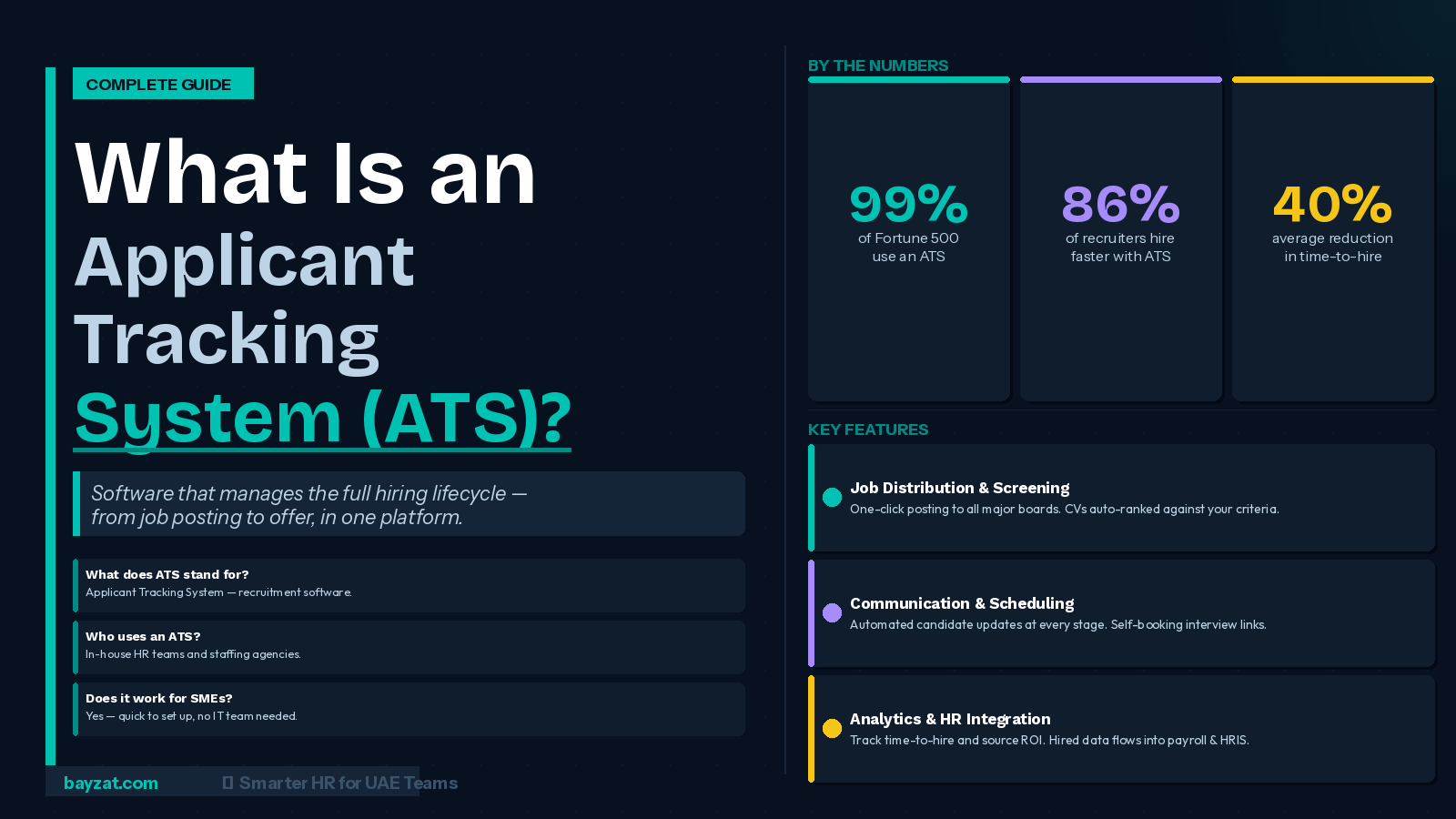
If you’ve spent any time in HR or recruiting, you’ve heard the term ATS. But what exactly is it, what does it do, and why does it matter؟ This guide […]
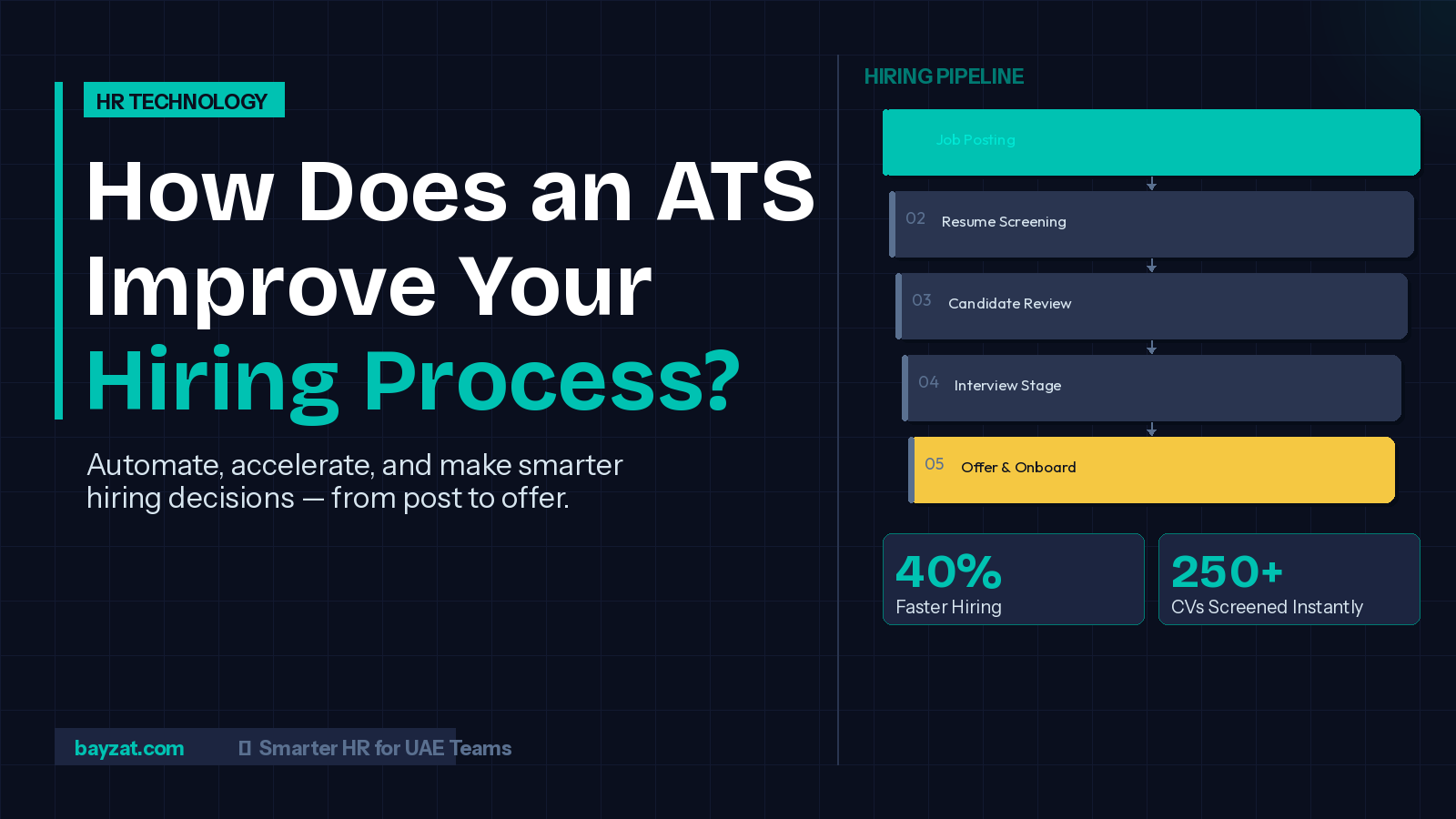
Hiring the right person has never been more competitive — or more costly. According to SHRM, the average cost per hire exceeds $4,700, and the average time to fill a […]

“The recruitment process in the UAE is so slow. It’s just very slow, unfortunately. It’s indecision in the process of hiring. It’s a cultural thing. No one wants to decide […]




Get Social