



If you’ve spent any time in HR or recruiting, you’ve heard the term ATS. But what exactly is it, what does it do, and why does it matter؟
This guide answers all of that, clearly and practically.
What Is an Applicant Tracking System?
An Applicant Tracking System (ATS) is software that helps recruiters and HR teams manage the entire hiring process from a single platform. It handles everything from posting job vacancies and collecting applications to screening candidates, scheduling interviews, and generating offer letters.
In short: an ATS replaces spreadsheets, email chains, and disconnected tools with one organized, automated system.
The term is sometimes used interchangeably with “recruitment software” or “talent acquisition software,” but at its core, an ATS is built around one purpose — tracking candidates from the moment they apply to the moment they’re hired.
What Does ATS Stand For?
ATS stands for Applicant Tracking System. In HR, it refers to the category of software designed specifically to manage job applicants and recruitment workflows. You may also hear it called a candidate tracking system or recruitment management system — these all refer to the same concept.
How Does an ATS Work?
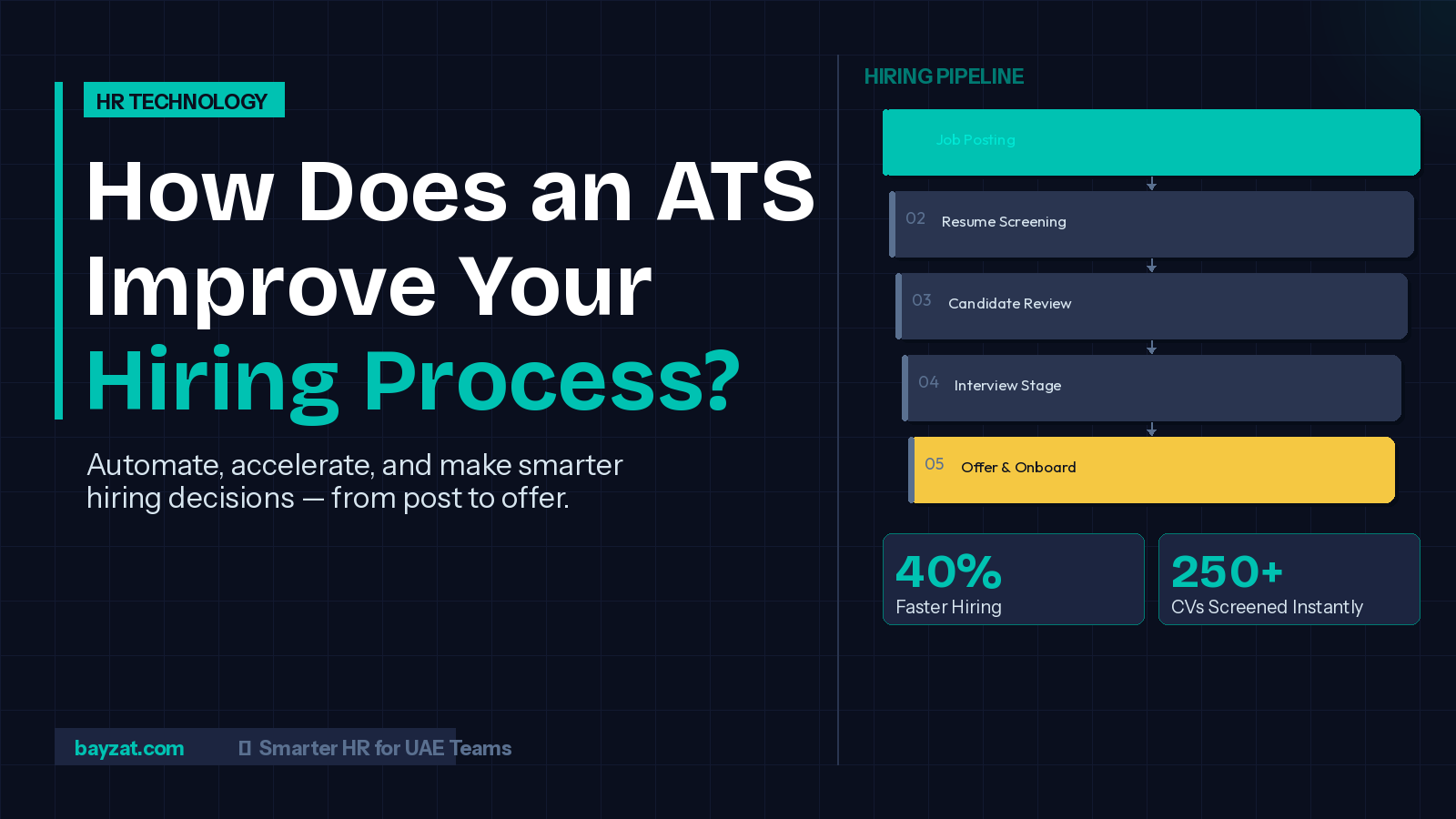
An ATS sits at the center of the recruitment process and connects every step in the hiring journey:
- Job creation — HR creates a job requisition inside the ATS with requirements, salary range, and target hiring date
- Multi-channel posting — The ATS distributes the job to multiple boards (LinkedIn, Indeed, Naukrigulf, etc.) in one click
- Application collection — All applications arrive in one place, regardless of source
- Resume parsing — The system automatically reads and structures each CV into a consistent format
- Screening and ranking — Candidates are filtered and scored against predefined criteria
- Pipeline management — Candidates move through customizable stages (Applied → Screening → Interview → Offer)
- Communication — Automated emails keep candidates updated at each stage
- Interview scheduling — Self-scheduling links eliminate back-and-forth coordination
- Offer generation — Offer letters are created and sent for e-signature directly from the system
- Onboarding handover — Hired candidate data flows into HR and payroll systems automatically
This end-to-end flow is what separates a modern ATS from a simple spreadsheet or inbox folder.
Key Features of an ATS
Not every ATS is the same, but the most effective platforms share a core set of capabilities:
- Job posting and distribution — Post to multiple job boards simultaneously from one dashboard, and track which channels generate the best applicants.
- Resume parsing — Automatically extract and structure candidate data from CVs so recruiters can compare candidates fairly and quickly.
- Candidate pipeline — A visual, stage-by-stage view of every candidate across all open roles, so nothing falls through the cracks.
- Automated communication — Email templates and triggers that keep candidates informed at every stage without manual follow-up.
- Interview scheduling — Candidates select interview slots from recruiter-defined availability, with automated confirmations for all parties.
- Hiring manager collaboration — Structured scorecards and in-system feedback so all stakeholders can evaluate candidates consistently.
- Reporting and analytics — Dashboards tracking time-to-hire, cost per hire, source effectiveness, pipeline conversion rates, and more.
- Integration with HR systems — Seamless data handover to payroll, HRIS, and onboarding tools once a candidate is hired.
Who Uses an ATS?
ATS platforms serve two main audiences, each with distinct needs:
In-house HR teams and recruiters use an ATS to manage hiring for their own organization. The focus is on moving candidates through the pipeline efficiently, maintaining a positive employer brand, and ensuring every hire is documented and compliant.
Staffing agencies use an ATS to manage candidates across multiple client organizations simultaneously. Agency-focused ATS platforms often include client portals, candidate databases, and bulk communication tools designed for high-volume placements.
The ATS increasingly plays a role in compliance too — maintaining audit-ready records for each hire in line with UAE & KSA labor law requirements and free zone regulations.
Benefits of an ATS
The business case for an ATS is straightforward:
- Faster hiring — Organizations using an ATS typically reduce time-to-hire by 20–40% through automation of manual steps. 86% of recruiters report that an ATS has helped them hire faster.
- Better quality of hire — Structured screening criteria and standardized evaluation scorecards reduce the influence of bias and improve decision consistency. 78% of recruiters using an ATS report improved quality of candidates hired.
- Lower cost per hire — Fewer manual hours, less reliance on expensive external agencies, and smarter sourcing decisions driven by channel analytics all reduce the overall cost of filling each role.
- Stronger candidate experience — Mobile-friendly applications, timely updates, and self-scheduling keep candidates engaged. A better experience means better offer acceptance rates and stronger employer brand.
- Compliance and audit trails — Every action in the hiring process is time-stamped and documented, which is essential for organizations subject to employment regulation and data privacy requirements.
ATS vs. Spreadsheets: A Quick Comparison
|
Capability |
Spreadsheet |
ATS |
|
Job posting |
Manual, one board at a time | Multi-board in one click |
|
Application collection |
Email inbox |
Centralized pipeline |
|
Resume screening |
Manual review |
Automated ranking |
| Candidate communication |
Ad hoc emails |
Automated, templated |
|
Interview scheduling |
Email back-and-forth |
Self-scheduling |
|
Reporting |
Manual calculation |
Live dashboards |
|
Compliance records |
Inconsistent |
Centralized, audit-ready |
What Should You Look for in an ATS?
If you’re evaluating ATS platforms for your organization, focus on these questions:
Does it fit your hiring volume?
A company hiring 10 people a year needs different functionality than one hiring 500. Make sure the platform is built for your scale.
Does it integrate with your existing HR tools? The most valuable ATS doesn’t operate in isolation — it connects with your payroll system, HRIS, and onboarding tools so data flows automatically.
Is it easy for non-technical users? Your hiring managers and interviewers need to use it too. A platform that requires IT training to operate will slow adoption and undermine the investment.
Does it offer analytics? You should be able to measure time-to-hire, source quality, and conversion rates from day one. If the platform can’t tell you what’s working, you’re flying blind.
How Bayzat’s ATS Fits In
Bayzat’s recruitment module is built as part of a fully integrated HR platform — not a standalone tool. That means the moment a candidate accepts an offer, their data flows directly into payroll, leave management, and employee records. No manual re-entry. No dropped handovers.
Bayzat offers a branded careers portal, customizable hiring stages, automated interview scheduling, and e-signature offer letters — all within the same platform you use to run payroll and manage employee benefits.
Frequently Asked Questions
What does ATS stand for in recruiting?
ATS stands for Applicant Tracking System — software that manages the full recruitment process from job posting to offer acceptance.
Is an ATS only for large companies?
No. Modern ATS platforms like Bayzat are designed for SMEs and can be set up quickly without technical expertise. Even organizations hiring 10–20 people per year benefit from the structure and automation an ATS provides.
What is the difference between an ATS and HRIS?
An ATS manages the recruitment and hiring process (pre-employment). An HRIS (Human Resource Information System) manages employee data post-hire — payroll, leave, performance, and more. The best HR platforms, like Bayzat, combine both into one connected system.
How long does it take to implement an ATS?
A modern cloud-based ATS can be up and running in days, not months. Platforms like Bayzat are designed for fast setup with minimal IT involvement.
An ATS is the foundation of a modern, efficient hiring process. Whether you’re a growing startup or an established enterprise in the middle east, the right system will help you hire faster, reduce costs, and build the kind of candidate experience that strengthens your employer brand.
Want to see how Bayzat’s ATS works end-to-end? Book a free demo and discover how GCC companies are transforming their recruitment.

If you’ve spent any time in HR or recruiting, you’ve heard the term ATS. But what exactly is it, what does it do, and why does it matter؟
This guide answers all of that, clearly and practically.
What Is an Applicant Tracking System?
An Applicant Tracking System (ATS) is software that helps recruiters and HR teams manage the entire hiring process from a single platform. It handles everything from posting job vacancies and collecting applications to screening candidates, scheduling interviews, and generating offer letters.
In short: an ATS replaces spreadsheets, email chains, and disconnected tools with one organized, automated system.
The term is sometimes used interchangeably with “recruitment software” or “talent acquisition software,” but at its core, an ATS is built around one purpose — tracking candidates from the moment they apply to the moment they’re hired.
What Does ATS Stand For?
ATS stands for Applicant Tracking System. In HR, it refers to the category of software designed specifically to manage job applicants and recruitment workflows. You may also hear it called a candidate tracking system or recruitment management system — these all refer to the same concept.
How Does an ATS Work?
An ATS sits at the center of the recruitment process and connects every step in the hiring journey:
- Job creation — HR creates a job requisition inside the ATS with requirements, salary range, and target hiring date
- Multi-channel posting — The ATS distributes the job to multiple boards (LinkedIn, Indeed, Naukrigulf, etc.) in one click
- Application collection — All applications arrive in one place, regardless of source
- Resume parsing — The system automatically reads and structures each CV into a consistent format
- Screening and ranking — Candidates are filtered and scored against predefined criteria
- Pipeline management — Candidates move through customizable stages (Applied → Screening → Interview → Offer)
- Communication — Automated emails keep candidates updated at each stage
- Interview scheduling — Self-scheduling links eliminate back-and-forth coordination
- Offer generation — Offer letters are created and sent for e-signature directly from the system
- Onboarding handover — Hired candidate data flows into HR and payroll systems automatically
This end-to-end flow is what separates a modern ATS from a simple spreadsheet or inbox folder.
Key Features of an ATS
Not every ATS is the same, but the most effective platforms share a core set of capabilities:
- Job posting and distribution — Post to multiple job boards simultaneously from one dashboard, and track which channels generate the best applicants.
- Resume parsing — Automatically extract and structure candidate data from CVs so recruiters can compare candidates fairly and quickly.
- Candidate pipeline — A visual, stage-by-stage view of every candidate across all open roles, so nothing falls through the cracks.
- Automated communication — Email templates and triggers that keep candidates informed at every stage without manual follow-up.
- Interview scheduling — Candidates select interview slots from recruiter-defined availability, with automated confirmations for all parties.
- Hiring manager collaboration — Structured scorecards and in-system feedback so all stakeholders can evaluate candidates consistently.
- Reporting and analytics — Dashboards tracking time-to-hire, cost per hire, source effectiveness, pipeline conversion rates, and more.
- Integration with HR systems — Seamless data handover to payroll, HRIS, and onboarding tools once a candidate is hired.
Who Uses an ATS?
ATS platforms serve two main audiences, each with distinct needs:
In-house HR teams and recruiters use an ATS to manage hiring for their own organization. The focus is on moving candidates through the pipeline efficiently, maintaining a positive employer brand, and ensuring every hire is documented and compliant.
Staffing agencies use an ATS to manage candidates across multiple client organizations simultaneously. Agency-focused ATS platforms often include client portals, candidate databases, and bulk communication tools designed for high-volume placements.
The ATS increasingly plays a role in compliance too — maintaining audit-ready records for each hire in line with UAE & KSA labor law requirements and free zone regulations.
Benefits of an ATS
The business case for an ATS is straightforward:
- Faster hiring — Organizations using an ATS typically reduce time-to-hire by 20–40% through automation of manual steps. 86% of recruiters report that an ATS has helped them hire faster.
- Better quality of hire — Structured screening criteria and standardized evaluation scorecards reduce the influence of bias and improve decision consistency. 78% of recruiters using an ATS report improved quality of candidates hired.
- Lower cost per hire — Fewer manual hours, less reliance on expensive external agencies, and smarter sourcing decisions driven by channel analytics all reduce the overall cost of filling each role.
- Stronger candidate experience — Mobile-friendly applications, timely updates, and self-scheduling keep candidates engaged. A better experience means better offer acceptance rates and stronger employer brand.
- Compliance and audit trails — Every action in the hiring process is time-stamped and documented, which is essential for organizations subject to employment regulation and data privacy requirements.
ATS vs. Spreadsheets: A Quick Comparison
|
Capability |
Spreadsheet |
ATS |
|
Job posting |
Manual, one board at a time | Multi-board in one click |
|
Application collection |
Email inbox |
Centralized pipeline |
|
Resume screening |
Manual review |
Automated ranking |
| Candidate communication |
Ad hoc emails |
Automated, templated |
|
Interview scheduling |
Email back-and-forth |
Self-scheduling |
|
Reporting |
Manual calculation |
Live dashboards |
|
Compliance records |
Inconsistent |
Centralized, audit-ready |
What Should You Look for in an ATS?
If you’re evaluating ATS platforms for your organization, focus on these questions:
Does it fit your hiring volume?
A company hiring 10 people a year needs different functionality than one hiring 500. Make sure the platform is built for your scale.
Does it integrate with your existing HR tools? The most valuable ATS doesn’t operate in isolation — it connects with your payroll system, HRIS, and onboarding tools so data flows automatically.
Is it easy for non-technical users? Your hiring managers and interviewers need to use it too. A platform that requires IT training to operate will slow adoption and undermine the investment.
Does it offer analytics? You should be able to measure time-to-hire, source quality, and conversion rates from day one. If the platform can’t tell you what’s working, you’re flying blind.
How Bayzat’s ATS Fits In
Bayzat’s recruitment module is built as part of a fully integrated HR platform — not a standalone tool. That means the moment a candidate accepts an offer, their data flows directly into payroll, leave management, and employee records. No manual re-entry. No dropped handovers.
Bayzat offers a branded careers portal, customizable hiring stages, automated interview scheduling, and e-signature offer letters — all within the same platform you use to run payroll and manage employee benefits.
Frequently Asked Questions
What does ATS stand for in recruiting?
ATS stands for Applicant Tracking System — software that manages the full recruitment process from job posting to offer acceptance.
Is an ATS only for large companies?
No. Modern ATS platforms like Bayzat are designed for SMEs and can be set up quickly without technical expertise. Even organizations hiring 10–20 people per year benefit from the structure and automation an ATS provides.
What is the difference between an ATS and HRIS?
An ATS manages the recruitment and hiring process (pre-employment). An HRIS (Human Resource Information System) manages employee data post-hire — payroll, leave, performance, and more. The best HR platforms, like Bayzat, combine both into one connected system.
How long does it take to implement an ATS?
A modern cloud-based ATS can be up and running in days, not months. Platforms like Bayzat are designed for fast setup with minimal IT involvement.
An ATS is the foundation of a modern, efficient hiring process. Whether you’re a growing startup or an established enterprise in the middle east, the right system will help you hire faster, reduce costs, and build the kind of candidate experience that strengthens your employer brand.
Want to see how Bayzat’s ATS works end-to-end? Book a free demo and discover how GCC companies are transforming their recruitment.

Noor Gharib
Related Articles
Hiring the right person has never been more competitive — or more costly. According to SHRM, the average cost per hire exceeds $4,700, and the average time to fill a […]

“The recruitment process in the UAE is so slow. It’s just very slow, unfortunately. It’s indecision in the process of hiring. It’s a cultural thing. No one wants to decide […]

Attracting the best talents in the UAE has become a rat race as many companies’ HR seek to outsmart each other. Every firm is constantly strategising to attract the most […]





Get Social